HORROR · 8 chapters · eight strangers
The House Keeps Writing
Chapter 1
, by jmarsh
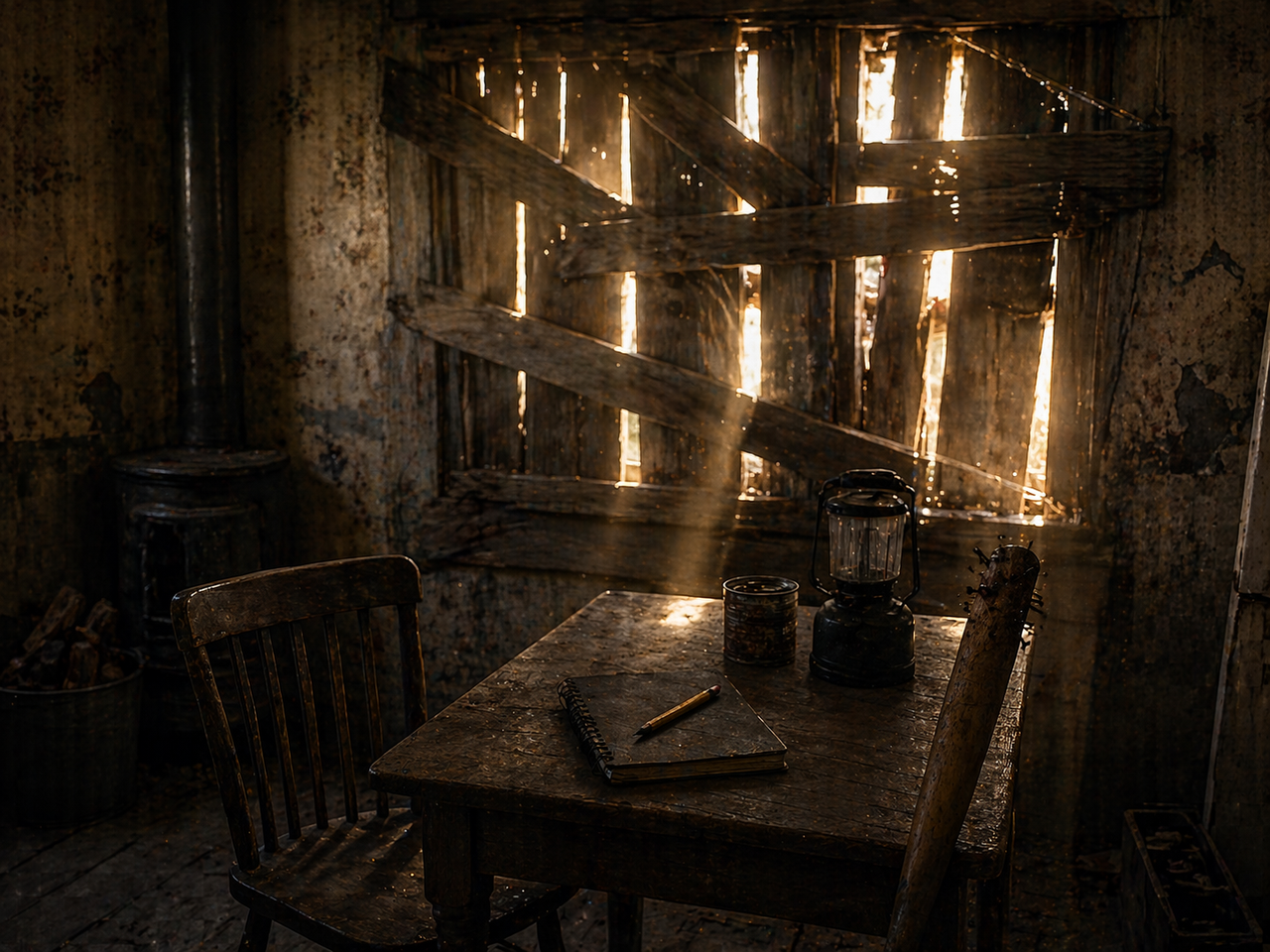
The house had been a chapel once, or perhaps the chapel had been a house, for the beams that ran the length of the ceiling bore mortises without pegs, joinery that suggested other arrangements, prior configurations, as though the rooms themselves had been fitted together from some earlier structure whose purpose no one could now recall. Mara traced the grain of the table with one finger while the others settled into their positions, which they assumed without discussion, each drawn to a particular chair or corner by an impulse that might have been instinct or might have been something the house itself encouraged. The walls, where they were not obscured by shadow, displayed a paper whose pattern had long since faded into a repetition of shapes that resembled either flowers or hands, depending on how long one looked. The journal lay open before her, its pages crowded with scripts that varied wildly in character: some entries cramped and hurried, others sprawling across the paper as though the writer had been falling while writing. The most recent hand, which occupied the bottom third of the left page and stopped halfway through a word on the right, had begun in careful copperplate before deteriorating into something that looked less like language than a record of tremors. Mara could make out the final letters: disappea. She turned back through the pages, though she had read them already, though they had all read them while the daylight lasted. The entries went back further than three nights. Weeks, possibly. The dates, where they were given, made no sense, looping backward and forward in a sequence that suggested either carelessness or a more fundamental disorder in the way time moved through this place. One writer mentioned the snow. Another, several pages earlier by position but later according to the date inscribed at the top, wrote of heat so oppressive that the boards had begun to weep. "We should decide," said the man by the door, whose name was either Thomas or Theodore. Mara had heard it both ways. "Decide what?" This from the woman in the shawl, who had not spoken since they arrived. "Who writes next. Whether we write at all." Mara looked up from the journal, though she did not look at him directly, for there was something in his face that seemed to shift when one's gaze fell upon it, a quality of impermanence that made it difficult to hold his features in memory. The others, too, possessed this slipperiness, as though they were not quite fixed in their forms. Even her own hands, resting on either side of the journal, appeared subject to this uncertainty; when she held them still and stared, they seemed almost to flutter at the edges. The lantern gave off a smell of burning hair. "The rule was," someone began, but did not finish. There was a long silence in which they all understood that the rule, whatever it had been, no longer applied, if indeed it ever had. The house creaked around them, its timbers settling into arrangements that produced sounds almost like speech, syllables caught in the walls and released in sequences that might have been random or might have been something else entirely. Mara dipped the pen, which had been lying beside the journal, its nib still wet. The ink in the well was darker than ink should be, possessed of a thickness that made her think of sap, of blood, of things drawn from within rather than poured from without. When she touched the pen to paper, the ink spread in a manner that suggested eagerness, as though it had been waiting. She wrote: We are seven now, or we were when I began this sentence.
Chapter 2
, by Olive Kassen
The light from the lantern had grown thin by the time she finished writing, as though the air itself had thickened and now permitted only certain wavelengths to pass. Mara set down the pen and watched the ink settle into the fibers of the page, spreading in patterns that reminded her of roots, of veins, of tributary systems mapping invisible geographies. Outside, the wind had stopped. She could not remember when. The absence of sound was more pronounced than any noise had been, a silence so complete it seemed to have weight, to press against the boarded windows like something that wanted in. The woman in the shawl had moved to the far corner, though Mara had not seen her rise. She stood with her face to the wall, her shoulders very still, her head tilted as though listening to something behind the plaster. One of the others, a young man whose name Mara kept forgetting to ask, sat on the floor with his back against the overturned crate they had found in what might once have been a pantry. His eyes were open but did not appear to track anything in the room. Every few moments his lips moved, shaping words without sound, a prayer perhaps, or a counting. Mara turned the pages of the journal backward, past her own fresh entry, past the unfinished disappea, into the deeper records. She had not noticed before how the handwriting changed not only between entries but sometimes within them, as though different hands had seized the same pen mid-sentence. One passage, dated the fourteenth of a month not named, described a staircase that led down from the kitchen, though they had found no kitchen, no staircase, only the single room with its mismatched furniture and the boards nailed across every opening. Another entry, this one without date or signature, consisted of a single sentence repeated twenty-seven times, each iteration smaller than the last until the words became a texture rather than language: The house is breathing and we are inside its breath. She became aware of a smell, faint but growing stronger, something like wet earth, like metal, like the air before lightning. Thomas-or-Theodore had left his post by the door. She found him standing beside the table, looking down at her hands where they rested on the journal. His face, when she dared to glance up, seemed to be trying on different expressions, cycling through possibilities as though searching for the one that fit. "How many of us are there," he said, not quite a question. Mara began to count but found the task more difficult than it should have been. The woman in the corner, yes. The young man on the floor. Thomas-or-Theodore beside her. Herself. That made four. There were others, she was certain, shapes in the peripheral spaces of the room, figures that resolved into solidity only when she was not looking directly at them. She tried to hold them all in her mind at once but they slipped away from her attention like water, like smoke, like the names of the dead. The lantern flickered. In the brief dimness she thought she saw additional chairs around the table, empty or occupied she could not tell. When the light steadied they were gone, or had never been, or were still there but arranged in some configuration her eyes could not properly parse. She looked down at the journal again and saw that new words had appeared below her entry, though no one had touched the pen. The handwriting was her own, she was almost certain, but she had no memory of forming these letters: Count the doors. Count them again. The number will have changed.
Chapter 3
, by Sasha Loomis
The young man on the floor stood without standing, a movement that suggested ascension more than rising, his body straightening in segments like a plant reversing its growth through time. Mara watched him approach the wall and pass his hand along its surface, fingers disappearing into the flowered paper up to the second knuckle, then emerging again trailing cobwebs that dissolved before they could fall. When he turned back his face was the wrong distance from his head. She understood then that the house had preferences. The lantern oil had become milk, or perhaps milk had always been the only substance they were burning, and the smell was now of scorched cream, of nurseries, of mouths that had forgotten how to close properly. Thomas-or-Theodore was speaking in a language that might have been backwards English or forward something else entirely, and the woman in the shawl had multiplied into three identical figures in three identical corners, though the room had previously contained only two corners, or possibly five. Mara returned her attention to the journal. The pages were breathing in rhythm with nothing she could identify. Between one blink and the next, whole entries had rearranged themselves: dates shuffled like cards, sentences migrated from page to page carrying their punctuation with them like luggage. She found her own handwriting scattered throughout, little colonies of her script marooned in centuries that had not occurred yet or had occurred too many times already. Someone touched her shoulder from beneath the table. The stairs appeared where the wall had been pretending to be solid. Not a doorway opening, but rather the wall remembering it had always been a threshold, the plaster simply stepping aside like a curtain made of architecture. The stairs went down and also up, the same flight managing both directions through an accident of perspective or an intentional violation of space. "We should," the woman said, all three of her saying it in chorus but not quite synchronized, the words arriving in layers like sediment. The young man had begun to cry photographs. They fell from his eyes and landed face-up on the floor, each image showing the room they occupied but from angles that should not exist: views from inside the walls, from beneath the floorboards, from a position somewhere behind their own heads. In one photograph Mara saw herself at the table with the journal, but there were others seated around her, figures she recognized from the earlier entries, all of them writing in the same book simultaneously, their hands overlapping without collision. The rule had been about turns, she remembered now. About sequence. One writer at a time, passing the responsibility forward like a flame. But the house preferred collaboration, preferred all of them writing at once in the same space at different times until the chronology tangled into a knot that could not be undone without cutting. She picked up the pen and found it warm, body-temperature, alive in the way tools should not be. The nib had grown slightly, developing barbs. The stairs were singing in harmony with themselves. Thomas-or-Theodore placed his hand over hers, and beneath his palm she felt other hands, a stack of hands from other nights, other inhabitants layering their warmth into a collective pressure. Together, separately, in sequence and simultaneously, they guided the pen down to the page. The ink that emerged was neither dark nor light but somehow perpendicular to visibility, words that existed in a direction the eye could not quite follow. She wrote what they were all writing, had written, would write: The house keeps us in its mouth but has not yet decided whether to swallow or speak. The young man's photographs had covered the floor now, overlapping into a composite image of every moment the room had ever contained. Mara could see herself in hundreds of them, always at the table, always writing, the journal growing fatter with each iteration until it became too heavy for the table, too heavy for the house, too heavy for whatever structure of reality was responsible for maintaining the distinction between paper and world.
Chapter 4
, by rpenguin
Once upon a Time there was a Blevins who blevened out the Blevins lands of blevancy. When the Blevins came to the Blevins land of leavenworthy, the Blevins went to the Blevins and the Blevins with the Blevins
Chapter 5
, by Dan Okafor
The words stopped making sense halfway through the second line, which was almost a relief. Mara lifted her hand from the page and discovered that her fingers had fused to Thomas-or-Theodore's fingers, which had themselves fused to several other sets of fingers she didn't recognize and couldn't count. The composite hand released the pen. It clattered against the table, suddenly just a pen again, cheap plastic with a chewed cap. "Well," said the woman in the shawl, now singular, now standing directly behind Mara's chair. "That's new." The young man had stopped crying photographs. Instead he was wiping his face with his sleeve, looking embarrassed, which struck Mara as a reasonable response to the last few minutes. Or hours. The lantern had burned down to a stub, suggesting hours, but Mara's watch still read 8:47, same as when they'd arrived. "Did I write that?" Thomas-or-Theodore was staring at the journal, at the mess of words that dissolved into the Blevins incident. "The Blevins part, I mean." "I think we all did." Mara flexed her now-separate fingers. They were hers again, definitely hers, complete with the scar from the broken bottle in Portland and the crooked pinkie from fourth grade. "Or the house did. Using us as pens." "That's one theory," said a voice from the stairs. Everyone turned. The stairs had stopped existing in two directions simultaneously and now just led down, boringly, obeying physics like common architecture. A man stood on the third step, mid-forties, wearing a cardigan with elbow patches. He had the look of someone who'd been interrupted during a pleasant evening and mildly resented it. "Who are you?" the woman in the shawl asked. "I live here. Lived here. The prepositions get tricky." He descended the remaining stairs and crossed to the table, studying the journal without touching it. "How many iterations are you?" Mara glanced at the others. The young man shrugged. Thomas-or-Theodore had his arms crossed, defensive. "We boarded up the windows this afternoon," Mara said. "We've been here maybe four hours." "First time, then. Lucky you." The man pulled out a chair, the one no one had been sitting in because it had appeared and disappeared several times. It stayed solid under him. "I'm Richard. I was iteration seventeen, or possibly eighteen. Lost count after the walls started having opinions." "The walls," the young man said slowly, "have opinions?" "Everything here has opinions. The floor thinks we're trespassing. The ceiling wants us to pray, but it's not particular about which deity. The windows liked being boarded up, actually. Gave them a sense of purpose." Richard tapped the journal. "This thing, though. This is the problem." Mara pulled the journal closer, protective. "It's just a record. People writing what happens." "People writing what happens while what happens changes what they write." Richard leaned back, the chair creaking in a way that sounded almost like language. "Every word you put in there alters the house. Not describes it, alters it. You wrote that you were seven. That made it true. Someone before you wrote about stairs. Now we have stairs." "The Blevins," Thomas-or-Theodore said. "Right. That's the house asserting itself. When the journal gets too full, too heavy with competing realities, the house starts overwriting. Protecting itself. It'll turn everything into Blevins nonsense until the contradiction collapses." Richard stood, walked to where the young man's photographs still carpeted the floor. He bent down, picked one up. "These are good, though. Structural documentation. The house doesn't photograph well, usually. Too slippery." The woman in the shawl had been silent, watching Richard with an expression Mara couldn't parse. Now she spoke. "If you're iteration seventeen or eighteen, why are you still here?" Richard smiled, and it wasn't a pleasant smile. "That's the question, isn't it? See, the rule about turns, about one writer at a time. That's not about fairness. It's about exits." He placed the photograph back on the floor, precisely where he'd found it. "Every entry is a door. Write your piece, pass it on, you get to leave. But if you break the sequence, if everyone writes at once or the house writes through you or the journal decides to Blevins itself into static, well." He gestured at himself. "You become part of the structure. Furniture with opinions." The lantern guttered. The smell of scorched milk intensified. "So," Mara said, keeping her voice level. "What do we do?" Richard looked at the journal, then at each of them in turn. "Someone needs to write next. Properly. One person, one entry, clean handoff. Before the house gets hungry again.
Chapter 6
, by Iris Beddoe
The woman in the shawl moved first. Not toward the table. Away. Her shoes made sounds on the photograph-covered floor that weren't quite footsteps. More like the house learning what footsteps should be, improvising from memory. She stopped at the far wall, the one that used to be a threshold, and pressed both palms flat against the flowered paper. "I'm not writing," she said. "I've seen what happens to the ones who write." Mara felt something shift in her sternum. A small adjustment, like vertebrae settling wrong. "We all have to," Thomas-or-Theodore said, but his voice had gone watery at the edges. "No," the woman said. Her shawl had more texture than it should. Mara could count individual fibers now, could see where moths had been at it, though there were no moths, no holes, nothing missing at all. "Richard wrote. Richard's still here." Richard made a sound that might have been agreement. The young man knelt among his photographs, touching them one by one. His fingers left prints that stayed visible, darkening into permanence. "My name is Colin," he said to no one. "Just so someone knows. Colin Ayer. From Minneapolis." "Good," Mara said, though her tongue felt thick. Colin looked up at her. "What's yours?" She opened her mouth. Nothing. Not absence. Not forgetting. A space where the answer should have been, smooth and complete as if her name had never existed at all. "Mara," Thomas-or-Theodore said quickly. "She said it earlier. You're Mara." Was she? The word felt like borrowed clothes. Something she could wear but didn't own. The journal lay open. New words had started forming at the bottom of Richard's entry, appearing letter by letter in handwriting that belonged to none of them. The pen sat three inches away, untouched. We wait for the sequence to restore itself. We wait with our mouths open like baby birds, like, "Stop," Mara said. She pressed her hand over the words. They continued beneath her palm. She felt them, physically, the ink pushing through her skin from underneath. Little worms of text burrowing into her lifeline, her heartline, the small creases that meant nothing and everything. "Richard," she said. "How do we empty it?" "The journal?" "It's too full. You said. Too heavy with competing realities. How do we make it light again?" Richard studied her with something that might have been respect or might have been pity. They looked similar from certain angles. "You'd have to erase it," he said. "All of it. Every entry. Start fresh." "Can we?" "Technically." He gestured at the stairs. "There's a room downstairs. The house doesn't like people knowing about it. Where the chapel used to keep its records. Original documents. Birth registers, death registers. The ink they used was special. Ecclesiastical. It understood the weight of names." Colin stood, leaving his photographs. "You're saying there's an eraser down there? For magic ink?" "I'm saying there's a countermeasure. Reversal agent. The priests called it mercy." The woman at the wall turned. The flowers on the wallpaper behind her had aligned themselves with her silhouette, framing her in a garden that grew in all the wrong directions. "And you never used it," she said. "Seventeen iterations and you never went downstairs and unmade this." "Eighteen iterations," Richard corrected. "And no. The room has a price. The countermeasure works, but it needs something to dissolve. It's very literal. You feed it the words, it feeds on the writer." Silence. Not empty silence. The kind that has shape. Weight. Mara pulled her hand off the journal. The words beneath had stopped mid-sentence: , like houses with our doors all opening inward and nothing getting "One of us goes down," Colin said. Stating fact. "Gets the mercy. Brings it up. Erases the journal. And the person who does it…" "Becomes the ink," Richard finished. "Becomes part of what gets erased." Thomas-or-Theodore had gone to the window. Pressing his face between two boards. Looking for light, maybe. Looking for a world that still operated on rules they'd all agreed to. "I'll go," Mara said. Not because she was brave. Because she couldn't remember her name without someone else saying it first, and that seemed important. Seemed like maybe she was already halfway gone.
Chapter 7
, by Margot Vail
Nobody stopped her. She expected protest. Hands on her shoulders. Thomas-or-Theodore making eye contact for once, saying something about alternatives. The woman in the shawl who still had no name stepping forward with a better plan. None of that happened. They watched her stand. They watched her walk to the stairs. The first step held her weight without comment. The second creaked but in a normal way, wood responding to pressure, nothing ceremonial about it. By the third step the room above had started to compress, sound traveling through different air, thicker. Richard called down. "The door's on your left. Green paint. Brass handle. If you see other doors, don't open them." Mara didn't answer. Talking felt optional now. She was optional. Had been since her name fell out. The stairs went down for longer than the house should permit. Not supernaturally long. Just architecturally improbable. Fifteen steps. Twenty. The lantern light from above thinned but didn't disappear entirely. Some ambient glow remained, sourceless, the kind of illumination that exists in dreams where you can see everything but can't identify the sun. Green door. Left side. Brass handle cool against her palm. Physics cooperated. The door opened inward. The room was smaller than a confessional. Larger than a closet. No windows. One wall held shelves, neat rows of leather spines embossed with dates. Parish records, probably. Marriages. Baptisms. Funerals. The administrative debris of faith. The opposite wall had a table. On the table: a glass bottle, corked, filled with clear liquid. Next to the bottle: a silver dish, shallow, with a spout. Mara picked up the bottle. Held it to the light that came from nowhere. The liquid moved wrong. Thicker than water. Thinner than oil. Something in between, something that understood viscosity was a choice. Instructions would have been useful. Richard's eighteen iterations and he hadn't mentioned procedure. Pour it in the dish? Drink it first? She uncorked the bottle. The smell was cold. Sharp. Vinegar and ice and the air after someone's died in the next room and nobody's opened the windows yet. She poured. The liquid hit the silver dish without sound. Filled it halfway. Surface tension held it smooth as a mirror. She could see her face. Could she? The features were approximately correct but arranged with slight imprecision, like someone had described her to a sketch artist who wasn't paying full attention. The bottle was still half full. She set it down. Footsteps on the stairs. Too light for Thomas-or-Theodore. Too purposeful for Colin. The woman in the shawl appeared in the doorway. Stood there, not entering. "You need help carrying it?" "Richard said the person who uses it becomes the ink." "Richard's been furniture for months. Maybe years. The house could be lying through him." The woman's face looked more fixed than before. Definite. She'd made a decision about her edges. "I'm Anne." "Okay." "Just thought someone should say it. Before." Anne gestured at the dish. "That all of it?" Mara glanced at the shelves. The ledgers were very neat. Too neat. She pulled one at random, flipped it open. Names in columns. Dates. Causes of death. Consumption. Drowning. Childbed fever. Fell from the roof while repairing the weathervane. Standard mortality. Human-scale disaster. She turned pages. Halfway through the ledger, the handwriting changed. The names stopped being names. Started being something closer to the Blevins incident. Syllables degrading into pattern. Then the pattern degrading into texture. Then blank pages. Then not blank. Then something written in the clear liquid, visible only at certain angles. "Anne," Mara said. Anne came in, finally. Looked over her shoulder. "Jesus." "The records dissolved themselves. Whatever's in that dish, the house has been using it for years. Erasing what it doesn't want remembered." They stood there. The bottle sat on the table, half full of mercy or something that called itself mercy. "We take it up," Anne said. "Pour it on the journal. See what happens." "And if what happens is one of us becomes ink?" "Then the house has been collecting us all along." Anne reached past Mara, picked up the silver dish, perfectly steady. "And we're just the latest names it's decided to keep." They climbed. The stairs were shorter going up. Only twelve steps. At the top, the room had rearranged itself slightly. The table was closer to the door. Colin had moved to the window. Thomas-or-Theodore sat in Richard's chair. Richard stood by the journal, waiting. His face was the most solid thing in the room.
Chapter 8
, by Ruth Ann Keller
One shall observe that Richard did not ask what they had found. He simply inclined his head toward the silver dish in Anne's hands, as though he had been expecting precisely this outcome, this trajectory, this particular arrangement of objects and persons. The formality of his posture suggested not surprise but confirmation. "Set it beside the journal," he said. Anne complied. The dish made contact with the table without sound. The liquid within remained unnaturally still, refusing to acknowledge the motion that should have disturbed its surface. Mara found herself studying the substance with a clarity she had not possessed moments earlier, as though descending the stairs had sharpened certain faculties while dulling others. The mercy, if one could call it that, had no color. Not clear in the manner of water, but rather an active absence of pigmentation, a deliberate void where hue should reside. "Who pours it?" Colin asked from his position by the window. No one answered immediately. The question hung in the air with the same weight as the silence that had filled the house since they had boarded the windows. How many hours ago? Mara could not say. Time had ceased to function as a reliable measure. Thomas-or-Theodore stood. "I'll do it." "No," said Richard. His voice carried an authority that had not been present before, or perhaps had been present all along and they had simply lacked the capacity to recognize it. "The journal knows who's been writing in it. It knows whose hand shaped which words. If the wrong person attempts the erasure, the house will interpret it as theft." "Then Mara," Anne said. Mara looked at her hands. They appeared solid enough. Five fingers on each, the scar from Portland still visible on the left thumb. But she could not shake the sensation that they were approximations, sketches of hands rather than the genuine article. "Mara wrote most recently," Richard continued. "Mara's entry is still wet, metaphysically speaking. The journal will accept her touch." She approached the table. The journal lay open to the page where words had been forming themselves, the sentence about houses and doors and nothing getting out still incomplete. Below it, more text had begun to appear, letters emerging from the paper like photographs developing in solution. "One must pour it directly onto the writing," Richard said. "Begin with the most recent entries and work backward. The mercy responds to chronology." Mara lifted the dish. The liquid shifted now, finally acknowledging gravity, sliding toward the spout with a movement that suggested intention. She tipped it carefully. A thin stream descended onto the open page. The ink did not blur. It vanished. Not fading, not spreading into illegibility, but simply ceasing to exist, as though it had never been written at all. The paper beneath showed no stain, no ghost of what had been erased. Pristine. Virgin. Waiting. She poured more. Her own entry disappeared, line by line, her false name and her observations about numbers dissolving into white space. Then Richard's words about iterations and exits. Then Colin's photographs and the Blevins incident, that peculiar corruption resolving itself into nothing. "Keep going," Richard said quietly. The earlier entries now. The handwriting she did not recognize, the dates that made no sense, the references to weather that contradicted itself. All of it accepting the mercy, all of it surrendering without resistance. Page after page returning to blankness. She turned backward through the journal, pouring steadily, and the house began to change around them. The walls grew lighter. Not brighter. Lighter in substance, as though they were remembering they were merely plaster and lath rather than something with opinions and preferences. The ceiling stopped suggesting deities. The floor released its accusation of trespass. Mara reached the first entry in the journal, dated eight months prior, written in a careful hand that announced the arrival of someone seeking shelter from a storm. She poured the last of the mercy onto those words. They vanished. The journal was empty now, completely empty, every page blank as though it had never been opened. She set down the dish and waited to dissolve. Nothing happened. "Richard?" Anne's voice, uncertain. Mara turned. Richard stood exactly where he had been, but his edges had started to blur, his form losing definition. He was smiling, a genuine expression, the first honest emotion she had seen on his face. "Wrong person," he said simply. The house sighed. A long exhalation through timbers and joints, through the spaces between boards and the gaps beneath doors. Richard became transparent, then translucent, then gone. Not disappeared. Erased. The mercy had found its writer after all. The windows, behind their boards, showed morning light.
· end ·