ADVENTURE · 8 chapters · eight strangers
Where the Compass Fails
Chapter 1
, by Cora Lindgren
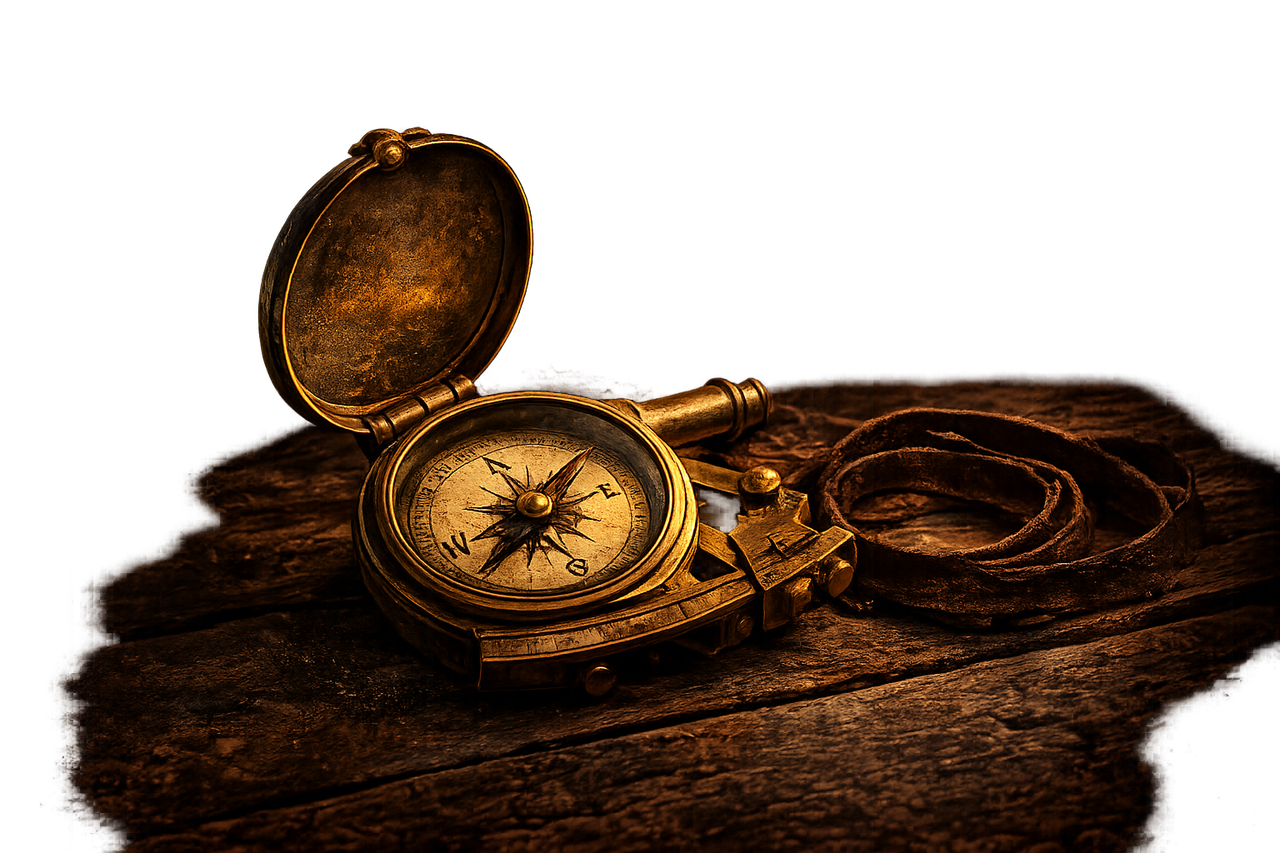
The compass smelled wrong. Mara held it flat in her palm, feeling the brass grow warm against her lifeline. Not warm like sunlight. Warm like something feverish, something alive. The needle swung past north, past east, circled back, and settled on a direction that didn't exist on any chart she'd studied in her father's workshop. She was three days into the Kettlebroke Range, where the slate cliffs sweated mineral water and the air tasted of copper. The map she'd inherited, the one folded so many times it had worn through at the creases, showed a pass here. But the mountains had shifted, or memory had, or the map had always been lying. The compass needle trembled. Pointed down. Mara knelt, pressed her cheek to the stone. Cold bit through to bone. She closed her eyes and felt it: a hollow space beneath, vast enough to swallow sound. The rock here was porous as old bread, and when she breathed out, she thought she felt the mountain breathe back. She'd brought rope, iron pitons, a hammer. She'd brought dried meat that tasted like leather and smoke. She hadn't brought faith, but her father had left her something else: the map's final notation, written in his last weeks when the shaking in his hands made the letters look like broken birds. Where the compass fails, drop. The crevice opened three yards west, a gash in the mountainside narrow enough she had to turn sideways to enter. Lichen crusted the entrance, spongy and slick under her fingers. She touched her tongue to it without thinking, an old habit from her apprentice days. Bitter. Faintly metallic. Alive. Inside, the temperature dropped. Her breath clouded. The walls pressed close enough she could feel the mountain's pulse against her shoulder blades, a rhythm that matched nothing human. She wedged herself down, boot soles squeaking against stone, until the crevice widened into a throat, then a gullet, then a space too large for her lamplight to measure. The compass burned hot enough now to blister. She dropped it. Heard it strike stone, bounce, strike again, then nothing. No final impact. Just the swallowing dark. But there was light below. Faint. Blue-green, like foxfire or deep water. It moved. Mara hammered in the first piton. The sound echoed wrong, came back fractured, came back as voices almost. She didn't let herself think about that. Thinking was what stopped you. She'd learned that watching her father in his final months, paralyzed by the weight of all the maps he'd never finished, all the places that had rearranged themselves while he was sleeping. The rope sang as she descended. Her hands knew this work, had known it since she was tall enough to reach her father's workbench. But her hands had never felt rock like this: warm in places, cold in others, textured like scar tissue, like something that had healed badly. Fifty feet down, the stone grew wet. Not dripping. Sweating. She tasted salt. A hundred feet, and the phosphorescence brightened. She could see the cave floor now, if it was a floor. It moved like water but caught the light like glass. Across its surface, shapes. Rectangular. Regular. Deliberate. Buildings. Submerged, or suspended, or growing from below. A city folded into the mountain's root. Mara's boot touched the not-water. It held her weight. Felt like walking on wet silk, like the membrane of something's dreaming. The buildings rose around her, their windows empty of everything except that strange light, pulsing now in time with the rhythm she'd felt in the stone. And on the nearest wall, carved deep enough to catch shadows: a map. Not her father's map. Not any map made by human hands. A map that moved.
Chapter 2
, by Sammy Hall
The thing about maps is they're supposed to stay still. That's the whole point, right? You draw a thing, it tells you where to go, you go there. Simple. Except this map didn't give a damn about simple. I stood there on that slick not-ground, watching lines crawl across the stone like veins filling with blood. They branched and split and doubled back on themselves. Some disappeared into cracks in the wall. Others surfaced where there'd been smooth stone a second before. I reached out to touch one and it flinched away. Actually flinched. The line shivered and reformed six inches to the left. Okay, I thought. Okay. This is fine. This is totally normal. My father's voice in my head: When something impossible happens, measure it. If you can measure it, you can map it. If you can map it, you can understand it. Sure, Dad. Except your compass is somewhere at the bottom of whatever I'm standing on, and your map led me to a place that isn't supposed to exist, and I'm pretty sure understanding is not actually on the menu here. The carved lines pulsed brighter. I stepped closer, trying to parse what I was looking at. There, a mountain range. Those could be rivers. That cluster might be buildings, or trees, or something I didn't have a word for. The scale kept shifting. One second I was looking at a continent, the next at something the size of my hand. Then I spotted it. A tiny figure, right at the center. Person-shaped. Moving. It took me way too long to realize it was me. I waved my left arm. The figure waved its left arm. I jumped. It jumped. I stood very still and tried not to think about the implications of a map that could see me while I was looking at it. Around my map-self, other marks. Symbols I didn't recognize. Some glowed steadier than others. One blazed so bright it hurt to look at straight on. It sat at the edge of the mapped area, in a space that seemed to fold in on itself like paper origami. I turned around, trying to orient myself. The not-water stretched in all directions, broken only by the buildings rising through it like bones through skin. The light came from everywhere and nowhere. No sun, no moon, no sense of up or down except what my inner ear insisted on. One of the buildings stood taller than the rest, maybe a hundred yards off. Its windows weren't empty like the others. Something moved behind them. Not light. Movement. The difference mattered, though I couldn't say why. When I looked back at the wall, a path had appeared on the map. A dotted line leading from my figure to the tall building. While I watched, words formed in the stone beneath the map. Not carved. Grown. The rock split and reformed around them like scar tissue spelling out a message. FOUR CAME BEFORE. THREE DESCENDED. TWO RETURNED CHANGED. ONE STAYS. Cool. Great. Super comforting. The phosphorescence in the not-water flickered. For just a second I saw what was below the surface. More buildings. More cities. Layers of them, stacked down into depths that made my stomach clench. And things moving between them. Shapes too big to be human, too purposeful to be fish. Something touched my ankle. I looked down. A tendril of that luminous not-water had curled around my boot like a curious cat. It didn't feel wet. It felt like being remembered by something that had forgotten it was supposed to forget you. The map pulsed once, hard. The dotted line flared bright enough to leave afterimages. I pulled my ankle free and the tendril retreated, sank back into the surface. When I looked up, the tall building's windows blazed with that same fierce light. The same color as the brightest symbol on the map. My father had written: Where the compass fails, drop. He hadn't written what to do after you landed. I tested the not-water with one boot. It held. Felt more solid than before, like it was learning what I needed it to be. That should have been reassuring. It really, really wasn't. The building waited. The map watched. Somewhere far above, the mountain breathed its slow stone breath. I started walking.
Chapter 3
, by rpenguin
Take it to the limt.
Chapter 4
, by Olive Kassen
The not-water learned quickly. By the tenth step it anticipated my weight, solidified before my boot made contact. By the twentieth it had developed texture, something like sand compressed under ice, something that gave just enough to feel intentional. The buildings grew larger as I approached, their proportions resolving into wrongness. Windows placed where no architect would put them. Doorways that narrowed at the top. Walls that leaned inward at angles that should have meant collapse. The tall building stood twice the height of the others. Its entrance was a vertical slash, darker than the surrounding stone. No door. Just an absence. The light behind those upper windows had steadied to a pulse, slow as a sleeping heart. I stopped at the threshold. The air here tasted different. Mineral and cold, but underneath that, something organic. Rot, maybe, or growth. The same smell as soil after hard rain, when the worms surface. Inside, the floor was actual stone. My boots echoed. The sound didn't fade, just kept reflecting until it became a texture, a pressure against my eardrums. The walls were carved with more of those maps, layers upon layers, some cutting through others like arguments. I traced one with my finger. The stone was warm. The line I'd touched flared and a section of wall to my left peeled back, smooth as skin. Behind it, stairs. They descended in a spiral, each step slightly different in height and depth, as if whoever built them had been learning the concept of stairs while constructing them. The walls curved close. I had to duck where the ceiling dropped without warning, then straightened into cathedral heights three steps later. The phosphorescence followed me down. It traveled through the stone itself, staying level with my head, lighting five feet ahead and behind. Convenient. That was the problem. Everything here was too convenient. The not-water that held me. The map that showed me where to go. The light that guided me. Things that help you are things that want something. Forty steps down, the spiral opened onto a landing. Three doorways led off it, each framed in that same pulsing light. The left doorway was smaller, child-sized. The right one was tall enough for something that wasn't human. The center one matched my height exactly. Of course it did. I chose left. Had to crouch to get through. The passage beyond was narrow, close, the walls pressing in like a birth canal or a throat. My shoulders scraped stone. The air grew thick, harder to pull into my lungs. I thought about turning back but the walls had already shifted behind me, sealing the entrance. Forward, then. The passage ended in a round chamber. Small. The ceiling just high enough to stand. And in the center, on a pedestal of that same warm stone, something I recognized. A compass. Not mine. Older. The brass green with age, the glass face cracked in a star pattern. When I leaned close I could see the needle. It spun slowly, continuously, never settling. Beneath the compass, words grown into the pedestal like the message on the wall above: FIRST SEEKER. FOUND THE DOOR. COULD NOT FIND THE WAY BACK. I touched the glass. The needle stopped. Pointed at me. Then swung hard right, toward the chamber wall, where another opening had appeared. This one my size exactly. The compass was hot now. Fever-hot, like mine had been. I left it there, spinning again the moment I lifted my hand. The new passage sloped upward. Water ran down it, real water this time, cold and clear. It soaked through my boots. The air changed, grew fresher. I could smell pine, snow, something like distance. The passage opened onto a platform cantilevered over nothing. Not the not-water. Actual nothing, a void so complete it hurt to look at. And across that void, maybe twenty feet away, another platform. On it, a door. Just standing there, freestanding, a wooden door with an iron handle. Beyond it, through it, I could see daylight. Trees. Sky. Between here and there, the air rippled like heat shimmer. Like something was deciding whether to be crossable. The map on my wall had shown four seekers. I'd found evidence of one. I looked down at the void. Looked up at the door. Started searching the platform for rope, for pitons, for anything I'd dropped or anything someone else had left behind.
Chapter 5
, by Colin McAteer
The platform holds nothing but dust and my own wet footprints tracking back into the passage. No rope. No pitons. No convenient bridge-building materials left by previous seekers who'd apparently had the good sense to bring actual equipment. I lie flat on my stomach and inch toward the edge. The stone is warm against my chest. Below, the void doesn't reflect light. It swallows it. I pick up a pebble from where the wall meets the floor and toss it into the gap. No sound. No impact. The pebble disappears. I stand up. Test my weight near the edge. The platform doesn't crumble. It's solid, dense, probably three feet thick. I kick at it. My boot connects with something that feels permanent. The door on the opposite platform swings open. Not from wind, there's no wind here. It opens inward, slow and deliberate, like someone on the other side is being polite. Through it I can see granite peaks, the kind I know. The kind I spent three days climbing to reach the crevice that led down here. The air that drafts through smells like October, like altitude, like the real world. The door swings shut. Opens again. Shuts. A rhythm. An invitation or a test. I pull off my pack and dig through it. Dried meat, water bottle, the folding knife my father gave me when I turned twelve. A length of cord, maybe fifteen feet, meant for tying down gear not spanning voids. I hold it up. Laugh once, sharp. The sound doesn't echo right here either. The heat shimmer between platforms intensifies. I can see shapes forming in it now. Not solid. Suggestions of form. They shift and re-form like oil on water. I watch one coalesce into something almost architectural, a bridge span that looks real for three seconds before it dissolves. Testing, I think. The void is testing what I expect to see. I close my eyes. Count to ten. Open them again. The shimmer has stilled. Where I'd been looking before, where I'd seen the almost-bridge, the air has thickened. It's not solid. But it's not nothing anymore either. I can see it bending light now, like glass, like water surface-tension holding its shape. I pick up another pebble. Toss it at the thickened air. It bounces. Hits something invisible six feet out and drops into the void. So. Not crossable yet. But responding. I sit down cross-legged at the platform's edge and stare at the space between. My father had a word for this, for the moment when a map showed you something impossible and you had to decide whether to trust it or trust your senses. He called it the cartographer's gap. The space between what is and what's drawn. The shimmer pulses. I keep staring. After five minutes, maybe ten, a path begins to clarify. Not solid. Not even visible in the normal sense. But I can perceive it now, a thinning in the void, a place where the nothing isn't quite as absolute. It extends from my platform at an angle, curves through the shimmer, reaches toward the other side but doesn't quite connect. I stand. Take three steps back. My legs know this motion. My body has made jumps before, across crevasses, between boulder faces. Never across a gap I couldn't measure. Never toward a surface I couldn't see. The door opens again. Stays open this time. Through it, I can see the exact spot where I hammered in my first piton. The rope is still there, hanging down from the real world. It sways slightly. Something is moving it from above. I run four steps and launch. The air catches me. Not gently. It feels like hitting a membrane, like the not-water's surface did, except this one gives more. I sink into it, my momentum carrying me forward and down simultaneously. My hands claw at nothing. My boots find something that yields but holds. I'm standing on air that isn't air. Three feet from the far platform. The membrane beneath me ripples outward from where my weight presses it. I take one step. It holds. Another step. My fingers close on stone. I haul myself onto the second platform and lie there, breathing hard. The door stands five feet away. Wide open. Daylight spills through it. Behind me, the shimmer collapses back into void. The path I just crossed ceases to exist. I get to my feet and walk toward the exit.
Chapter 6
, by jmarsh
The threshold exhales against my face, a breath that carries pine resin and the mineral sharpness of snow-melt, scents that belong to the outer world, to the mountains I descended from when the compass first trembled in my palm. I step through the doorway's frame and the stone beneath my boots transforms to soil, rich and yielding, studded with pale roots that writhe deeper as my weight compresses them. The door slams shut behind me with a sound like bone striking bone. I am not where I expected to be. The mountains rise before me, yes, but they have been rearranged. The peaks I know, the Kettlebroke Range with its distinctive triple summit that my father sketched a thousand times, now stand inverted in the distance, their points thrust downward into a sky that churns below them like stormwater. I stand upon a slope that curves upward in both directions, a ridge that should not be possible, that bends against every principle of geology I have studied. Gravity holds me to it nonetheless. My stomach lurches as my mind attempts to reconcile the contradiction between what my body feels and what my eyes report. The rope I saw through the doorway, my rope that should hang from the crevice entrance, dangles from a cliff face to my left. But the cliff grows from the sky itself, a tooth of granite suspended in the air above me, or below me, or beside me depending on which way I allow my vision to settle. The rope sways. Something climbs it. I can see the motion traveling down the line, rhythmic and purposeful, though I cannot yet discern what makes it. I turn back to the door. It has become a standing stone, monolithic and weathered, its surface carved with symbols that predate the maps I know. No hinges. No handle. The wood has transformed to granite, or perhaps was always granite and I simply needed to be on this side to perceive its truth. Around me, the landscape breathes. Not metaphor: the ground rises and falls in a steady cadence, slow as a sleeper's chest. Trees grow here, but they have planted themselves at angles that suggest they understand a different orientation of the world. Their branches point not toward sunlight but toward something else, some other source of nourishment that exists at a perpendicular to everything I know. I hear water. Follow the sound down the impossible ridge, my body adjusting to the curve of it, learning to walk on terrain that should spill me into the inverted sky. The sound grows louder. I find a stream, but it flows upward, defying every law, climbing the slope in defiance of sense. I kneel beside it. Cup my hands in its current. The water is cold and real. Tastes of iron and distance. When I drink, I feel it settle wrong inside me, as though my body too must learn new orientations. Movement on the hanging cliff. The rope goes taut. I shield my eyes against the strange light, this illumination that seems to emanate from the churning sky below rather than any sun, and I see what climbs. A woman. Dressed in clothes a century out of date, her skirt torn and bound up around her knees for easier movement. She reaches the rope's end where it is anchored to a piton driven into the suspended stone. She looks down, sees me, and her face registers no surprise. Only recognition. She unhooks herself from the rope and begins descending the cliff face without it, finding holds that should not support weight at these angles, moving with the certainty of someone who has made this journey many times. Her hands bleed. I can see the red of it even from this distance. Not fresh blood. Old wounds reopened with each climb. I stand and wait. There is nowhere else to go. The ridge extends in both directions toward horizons that curve incorrectly, that meet themselves in ways that hurt to follow. The stream flows upward into mist. The trees point toward their incomprehensible sun. The woman is closer now. Twenty feet above me, or below me, or simply distant across the warped geometry. She opens her mouth to speak and I hear her voice before the sound can travel, an effect of this place's fractured laws. "You're the fourth this year," she says, and her tone carries neither welcome nor warning. "The others went north. They haven't come back yet. That way, " she points along the ridge's curve ", leads to the second door.
Chapter 7
, by Lior Tannen
I should correct her, tell her I'm not the fourth this year but maybe the fourth ever, if the wall in the chamber told truth. But her hands stop me. The blood on them is real, the kind of real that makes you understand someone has been working at something far too long. She wipes her palms on her skirt, leaving rust-colored streaks across fabric that was probably gray once, maybe blue. Hard to tell under the dirt and the years. "You're bleeding," I say, because sometimes the obvious thing is the only thing you can offer. "It's the rope." She flexes her fingers, winces. "Climbs easier than the rock, but it takes its price. Everything here does." She sits down on the breathing ground without ceremony, pulls a canteen from her belt. The metal is dented, old, the kind they stopped making when my grandmother was young. She drinks, wipes her mouth with the back of one damaged hand. "Second door," I repeat. "How many are there?" "I've found three. Haven't been through the third yet." She nods toward the ridge's curve. "Didn't seem wise to try alone." The ground rises under us, exhales. I sit too, feeling the rhythm of it through my legs, my spine. Above us, or below, the inverted mountains catch light that comes from the wrong direction. The woman follows my gaze. "You get used to it. The turning. Your body learns faster than your head." She holds out the canteen. "Thirsty?" I am. The water I drank from the upward stream left me feeling hollow somehow, like it passed through me without touching the sides. I take the canteen. The water inside tastes normal, flatly normal, the most beautiful boring thing I've encountered since entering the crevice. I drink three long swallows before handing it back. "Thank you." "Eliza," she says. Not offering a handshake, probably because of the blood. "Been here seven months, near as I can figure. Time runs strange." Seven months. I think of the message carved in stone. One stays. "The others who came this year," I ask. "Did you see them? Talk to them?" "Two of them. They came through together, young men, brothers maybe. Had good gear, modern stuff. Didn't listen when I tried to warn them about the north path." She tucks the canteen away. "The third came alone. Woman about your age. She listened. We traveled together for a while, made it to the second door. She went through. I stayed." "Why?" Eliza looks at me then, really looks, and I see someone who has gotten older in this place in ways that have nothing to do with time. "Because the second door shows you something. Offers you something. And I wasn't ready to pay what it wanted." The rope on the hanging cliff sways again. Something else is climbing it now. Something with too many limbs, moving in a rhythm that makes my eyes ache. Eliza sees me staring. "They don't come down. Usually." "Usually?" "Usually." She stands, offers me her hand despite the blood. I take it. Her grip is strong, callused in places that speak of repeated motion, the same holds grabbed over and over. "We should move. When they start climbing, it means something's shifting. The doors, the paths. Things open that were closed. Things close that you thought you could reach." I shoulder my pack. Look back at the standing stone that was a door, that led me here from the chamber where a compass spins forever beneath a message about seekers. "My father mapped these mountains," I say. "The real ones. The ones that should be above us." "Mine did too." Eliza starts walking along the ridge, following its impossible curve. "Different mountains, probably. Different country. But same idea. Put down on paper what moves. Make sense of what shifts." She glances back at me. "They ever tell you what happens when you finish the last map?" "No." "Good. Means they didn't know either. Makes us even." I follow her. The breathing ground steadies under my feet, learning my gait. Behind us, the thing with too many limbs reaches the piton. The rope begins to fray.
Chapter 8
, by Iris Beddoe
The rope gives. Sound of fibers splitting. We don't run. Running on ground that breathes requires trust we haven't earned yet. We walk fast, Eliza leading, her boots finding purchase on the ridge's curve like she's memorized every exhale. "What was it," I ask. "The thing the second door wanted." "Your certainty." She doesn't look back. "The feeling that you know which way is up." The sky below us churns darker. I can see shapes moving in it now, vast and architectural. Cities maybe. Or the shadows cities cast. We pass a tree growing at ninety degrees to everything. Its roots grip air. Birds nest in its branches, small and gray, singing notes that arrive before they're sung. They watch us with interest that feels mutual. One drops from its perch and flies downward into the inverted sky, toward those churning shapes. "The brothers," I say. "The ones who went north. What did you warn them about." "The forgetting." Eliza stops at a place where the ridge splits. Two paths, both curving away into geometries that hurt to track. She kneels. Touches the ground. "Left goes to the second door. Right goes north. The brothers thought north meant back. Thought it meant out." "It doesn't." "North means deeper." She stands. "Means turning yourself inside out until you can't remember which parts were originally you." I think of the compass in that small chamber. The needle spinning, never settling. First seeker. Found the door. Could not find the way back. "How many ways back are there," I ask. "Haven't found one yet." She chooses the left path. "Found three ways forward, though. So that's something." The ground's breathing changes rhythm. Faster now. Shallower. Like it's anticipating something. Ahead, the path narrows. Stone walls rise on either side, except they're not walls. They're pages. Massive sheets of something like parchment, stretched vertical and covered in drawings. Maps, hundreds of them, overlapping and contradictory. I recognize none of the continents. None of the coastlines. My father's hand would have cramped trying to capture this. The impossibility of it. Eliza runs her damaged fingers along one page. The map there ripples, reforms. "They change when you touch them. Show you what they think you need to see." I touch a different page. The lines there shift. Suddenly I'm looking at my kitchen table, the one where I unrolled my father's last map. Coffee cups weighting the corners. Morning light through the window. There, drawn in fresh ink: this ridge. This path. These impossible walls of maps. And at the end, a door marked with a symbol I don't recognize. Below it, in my father's shaking hand: For Mara. For after. "He knew," I say. My voice sounds distant. "He'd been here. He knew what this place was." "Most of them did." Eliza keeps walking. "The mapmakers. The ones obsessed enough to pay too much for charts that shouldn't exist. They're the only ones who find the doors." The map-walls narrow further. We have to walk single file. I trail my hand along the pages, feeling them shift and whisper under my fingers. Each one shows me something different. My childhood home. My father's workshop. The moment I held the compass and felt it turn wrong in my palm. The passage opens onto a platform. The second door stands in the center. Not freestanding this time. It's part of something larger. A frame built from what looks like compressed distance, folded space, the gaps between places made solid. The door itself is glass. Through it I can see everything at once. Every map I've ever studied. Every place I've ever walked. Every version of the mountains, real and inverted, breathing and still. And beyond that, underneath that: the pattern. The way it all connects. The reason the compass failed. It's simple. Obvious. Terrible in its clarity. Eliza stands beside me. "You see it?" "Yes." "The woman who came before you, she saw it too. Went through anyway." I step closer. Press my palm against the glass. It's cold. Final. The kind of cold that means commitment. "What happens," I ask, "if I don't go through." "You become me." Eliza's voice is flat. "You climb the rope until your hands bleed. You warn the next ones. You find the third door and stand before it wondering if you should have chosen differently." "And if I go through?" "You learn whether your father was right." I look back at her. "About what." "That some places can only be mapped from the inside." I turn the handle. The glass door opens on silence. I step through.
· end ·