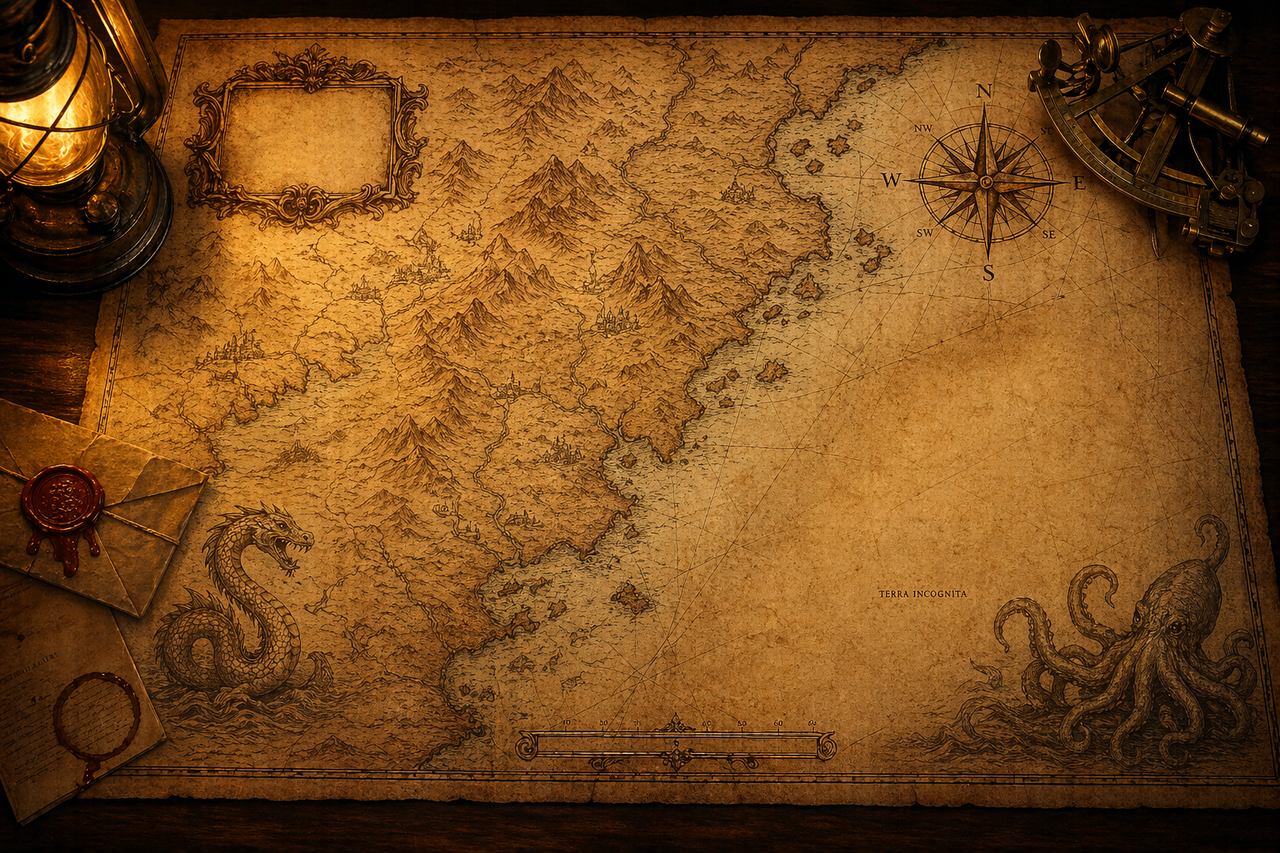
ADVENTURE · 8 chapters · eight strangers
Paths That Rewrite Themselves
Chapter 1
, by Margot Vail
The cartographer died in his chair. When they found him, his hands were still posed over an empty sheet of vellum, fingers stained blue from ink that wasn't there. The map he'd been drawing had vanished. Or it had never existed. The Guild investigators couldn't agree. They inventoried his workshop: three hundred and forty-seven completed maps, each one verified, each one corresponding to a known place. Cities, trade routes, coastlines. All accounted for. But his final commission log showed one more entry. Client name: illegible. Destination: a single word that might have been "Chrysopolis" or might have been something else entirely. The letters seemed to shift when you weren't looking directly at them. His apprentice, a girl named Maret, told them about the visitor. Tall, she said. Wore gray. Paid in coins that were warm to the touch. The Guild investigators asked to see the coins. Maret brought them a leather purse. Inside: forty silver pieces, perfectly ordinary, perfectly cold. They closed the investigation. Called it heart failure. Filed the incomplete commission under "Abandoned Works" and prepared to auction his tools. Maret stole the vellum sheet the night before the auction. It wasn't empty anymore. Or rather, it had never been empty. In certain light, at certain angles, lines appeared. Not drawn lines. Lines that existed in the paper itself, like veins, like the structure of ice. She held it up to the window at dawn and saw coastlines that weren't on any map she knew. Mountain ranges that couldn't exist. A city marked with a symbol she didn't recognize: a circle bisected by a vertical line, with three dots arranged in a triangle at its center. She knew what it meant to take an unverified map seriously. The Guild had rules about that. Maps were representations of tested fact, not speculation, not imagination, not desire. You could lose your certification for less. But her master had died with his hands in the air, drawing something only he could see, and the visitor in gray had paid for a destination with coins that were no longer warm. She packed light. The vellum, rolled tight. A compass that had belonged to her master. Bread, cheese, dried meat. A knife. Enough money to get her to the coast, if the map led to the coast, if it led anywhere. The first thing she learned: the map didn't stay the same. By the time she reached the city walls, the coastline had shifted. The mountains were in a different position. The city with the strange symbol had moved three inches north. Or the world had moved. Or she had. The second thing: other people were looking for it too. She saw the first one in a tavern outside the capital. He sat alone, studying a sheet of paper with the intensity of a man trying to remember something. She couldn't see what was on the paper, but she saw how he held it. The angle. The way he tilted it toward the window. When he left, she followed him for half a mile before losing him in a crowd. The second one was a woman, older, who asked the wrong questions in the right way. She came into the cartography shop where Maret had stopped to buy ink and asked if anyone had commissioned a map to a city called Chrysopolis. The shopkeeper said no. The woman left. Maret waited ten minutes, bought her ink, left by the back entrance. She checked her vellum that night. The city had moved again. And there was something new: a thin red line, like a thread, leading from where she was to where the city was. Except the line didn't go in a straight direction. It curved. It doubled back. In one place it seemed to spiral into itself before continuing. She followed it anyway.
Chapter 2
, by typewriter_tom
The road split three ways at a marker stone worn smooth by weather. Maret held the vellum flat against her palm. The red thread passed through the stone itself, impossible, unambiguous. She touched the marker. The stone was warmer than it should have been. A man sat on the eastern fork, thirty feet away. He hadn't been there a moment ago. Or she hadn't noticed. He was eating an apple, watching her with the mild interest of someone observing a bird. "You're the fourth this month," he said. Maret rolled the vellum and kept walking. The thread led north, between the forks. "There's no path that way." He bit into the apple. "Just thornbrake and deadfall for six miles. Then the drop." She pushed into the brush. Thorns caught her sleeves, her pack. Behind her, the man laughed once, brief and joyless. "The others said the same thing with their silence," he called. "None of them came back." The undergrowth thickened. Maret used her knife to cut through, following a direction that existed only on vellum that rewrote itself. The compass needle spun lazy circles, useless. After an hour, the thorns ended abruptly. She stood at the edge of nothing. The drop was sheer. A thousand feet, maybe more, into mist so thick it looked solid. But the red thread continued out over empty air, perfectly level, toward something she couldn't see. She unrolled the vellum. The thread pulsed slightly, the way a heartbeat might look if you could draw it. And there was new detail now: symbols marked along the thread itself, evenly spaced. The first one was at her feet. The second floated in the air above the drop. Maret picked up a stone and tossed it onto the space where the second symbol hovered. The stone landed. It sat there, in the air, on nothing. She stepped onto it. The mist swallowed her immediately. She felt the surface beneath her boots, solid, perhaps a foot wide. She slid her foot forward carefully. Still solid. The vellum was useless here. She couldn't see it in the mist. Couldn't see anything. She folded it away and moved by memory, counting steps. At twelve paces, her boot found the edge of nothing. She stopped, crouched, felt ahead with her hand. Another surface, offset from the first. She had to step down and sideways. A staircase built by someone with a broken understanding of geometry. The mist began to thin after the twentieth transition. She emerged into clear air, still walking on invisible surfaces, a thousand feet above ground that was now somehow below and behind her. Ahead, the path became visible: a bridge of white stone, narrow, leading to an island that hung in the sky without support or explanation. The city was there. Chrysopolis. It looked exactly like the symbol on the map: circular walls, a single spire at the center, three domed structures arranged in a triangle. But it was small. The whole thing would fit inside a wealthy merchant's estate. She crossed the bridge. The gates were open. Inside, the streets were empty but not abandoned. Fresh bread sat on a market stall. A fountain ran clear. Laundry hung drying in a courtyard. At the center, beneath the spire, a door stood open. Maret entered. The room was round, lit by windows that shouldn't exist in a tower this narrow. In the center: a table. On the table: a map. She approached slowly. The map showed Chrysopolis. And around it, scattered in the air like seeds, forty other islands. Each one with a city. Each city marked with a different symbol. Someone cleared their throat behind her. Maret turned. The visitor in gray stood in the doorway. Tall, as described. The coins in their hand glowed faintly, warm enough to see. "Your master," they said, "was the first in three hundred years to see clearly enough to finish. But he was too old to travel. So." They gestured at Maret, at the map, at everything. "We hired him to find us someone younger.
Chapter 3
, by Dan Okafor
Maret had several questions, but the one that came out was: "He died." "Yes," the visitor said. "That happens when you see all forty-seven cities at once." They said it the way someone might mention rain. She looked at the map on the table, then back at the visitor. "You killed him." "We paid him." The coins clicked together in their palm, a sound like distant bells. "He knew the price. Chose to look anyway. Some people can't help themselves." Maret's hand moved toward her knife. The visitor noticed but didn't react. "You're angry," they said. "That's reasonable. But you walked here anyway. Through the thornbrake. Over the drop. You could have stopped at any point." "You didn't give me a choice." "We gave you a map." The visitor stepped into the room. Up close, their gray coat wasn't fabric. It moved wrong. Like smoke held in the shape of cloth. "Everything after that was you." The map on the table showed the forty-seven islands in precise detail. Maret could see streets, buildings, the specific curve of each coastline. Her master had died drawing this. Or drawing something that led to this. She wasn't sure which was worse. "What do you want?" she asked. "The same thing we wanted from him. A cartographer." The visitor set the coins on the table. They were still warm. Maret could feel the heat from three feet away. "Someone to map the paths between." "Between the cities?" "Between the cities and the world you came from." The visitor pointed at the windows. Through them, Maret could see the other islands, each one floating separate and distant. "Right now, the only way here is the path you took. One path, drawn by one dead man, leading to one city. We need forty-seven paths. Stable ones. Paths that won't eat people." Maret looked at the map again. The red thread that had led her here was drawn in the same ink as the islands, the same hand. Her master's hand. "The thread tried to kill me." "It tried to test you," the visitor corrected. "The others failed. You didn't." "What others?" The visitor didn't answer. They walked to the window, looked out at nothing. "Your master drew the first path in three hundred years. Before him, Chrysopolis was myth. A story cartographers told about a city that moved. He made it real again. Fixed it in place." They turned back. "But one city isn't enough. There are forty-six more, and they're drifting farther every year. In another generation, they'll be gone completely." "Why?" Maret asked. "Why are there cities floating in the air? Why do they move?" "Wrong questions." The visitor picked up one of the warm coins, held it to the light. "The right question is: do you want to learn how to find them?" Maret thought about her master's hands, posed over empty vellum. The way the letters in his log had shifted. The apprentice's shop she'd left behind, the Guild certification she'd never technically earned. The woman in the cartography shop asking about Chrysopolis. The man on the road who'd watched three other people walk into the thornbrake and never come back. She thought about the path she'd walked here. Invisible stairs in the mist, built by someone who understood geometry differently than she did. "If I say no?" she asked. "You walk back. The path stays open now. You reached the end." The visitor shrugged. "You'll be the only living person who's seen Chrysopolis. That's worth something. Tell good stories, maybe write a book. The Guild will never believe you, but that's not new." Maret looked at the map on the table. Forty-seven cities, each one marked with a symbol she didn't recognize. Each one impossible. Each one waiting. "And if I say yes?" The visitor smiled for the first time. It wasn't a comforting expression. "Then you pick up where your master left off." They gestured at the table. Next to the map, a set of tools: brushes, ink, vellum, a knife for scraping away mistakes. "You learn to draw paths that don't kill people. You make the cities real again, one by one. And when you're done, assuming you survive, you'll know more about the shape of the world than anyone alive." They pushed the warm coins across the table toward her. "Fair payment," they said. "Same as your master got.
Chapter 4
, by Olive Kassen
The coins lay between them, radiating heat that bent the air above them into small waves. Maret watched those waves the way she'd once watched marsh gas rising at dusk, back when mapping meant walking known roads and measuring distances that stayed measured. She didn't touch the coins. Instead, she moved to the window. Below, or what should have been below, the world she'd left spread out in miniature. She could see the thornbrake from above now, a dark tangle that looked almost decorative from this height. The marker stone where the man had sat eating his apple. Beyond that, the pale thread of the road leading back to cities with names everyone agreed on. "The others who failed," she said. "Where are they?" The visitor joined her at the window. Their coat made no sound when they moved. "In the mist still. Or they turned back. Or they're at the bottom of the drop, which doesn't have a bottom in the way you'd think of one." They paused. "We don't track failures. Only successes." Maret turned from the window and walked to the table. The tools laid out there were fine work. Expensive. The brushes were sable, the knife's edge sharp enough to catch light. She picked up one of the blank vellum sheets stacked beside them. It was warm too. She held it flat, angled it toward the window. Nothing. No hidden lines, no veins of ink waiting to surface. Just cream-colored vellum with a texture like skin. "How did he do it?" she asked. "My master. How did he see the path clearly enough to draw it?" "He looked at Chrysopolis until it looked back." "That's not an answer." "It's the only one I have." The visitor returned to the table, touched the map of the forty-seven islands. Where their finger traced, the ink seemed to move slightly, settling into new configurations. "Cartography is measurement, yes. But measurement of what? Distance implies two fixed points. These cities aren't fixed." Maret set down the vellum. She thought about the red thread that had curved and doubled back on itself, the path that made no geometric sense. "They move relative to each other." "No. They move relative to you." The visitor lifted their hand from the map. The islands had shifted. Not much. A quarter inch here, less there. But enough that the distances between them had changed. "The world you came from thinks of itself as stationary," the visitor said. "The ground beneath your feet, the roads, the cities built on stone foundations. All of it fixed in place, and you move through it. Here, we're stationary. You're what moves." They gestured at the windows, the floating islands beyond. "Your master understood that. He stopped trying to measure distance and started measuring... something else." "What?" "Intention, maybe. Probability. The space between wanting to arrive and arriving." The visitor's smile returned, brief and mirthless as before. "I'm not a cartographer. I can't explain it the way he would have. But he could draw a path from here to there because he understood that 'here' and 'there' weren't geographic locations. They were states of mind made geographic." Maret looked at the map again. The symbol for Chrysopolis sat at the center, surrounded by forty-six others arranged in no pattern she recognized. Concentric circles, crescents, stars with varying points, a square bisected by diagonal lines. Each one different. Each one marking a city her master had seen clearly enough to name but not clearly enough to reach. "Which one is next?" she asked. The visitor's expression changed. Not quite surprise. More like recognition. "You're choosing, then." "I'm asking a question." "Same thing." They touched the map, indicating an island to the east of Chrysopolis. The symbol there looked like two triangles nested point to point. "Eliaster. It's the closest, relatively speaking. Three days' walk if the path is drawn correctly. Three years if it isn't." "And if I draw it wrong?" "You end up somewhere between. Or nowhere. Or you arrive but can't leave." The visitor pushed the warm coins closer. "This is why we pay in advance." Maret picked up one of the coins. The heat of it traveled up through her palm, into her wrist, settling somewhere near her heart. She thought about her master's hands frozen in the air, still drawing what only he could see. She thought about whether that was a good death or a terrible one. Then she pocketed the coin and reached for the brushes.
Chapter 5
, by Priya Nair
Maret picked up a brush and immediately put it down again. "No." The visitor tilted their head. "No?" "I'm not drawing anything until I know what I'm drawing with." She uncapped one of the ink bottles. The smell hit her first, sharp and mineral, like blood mixed with rust. The liquid inside wasn't black. It was every color at once, shifting as she watched. "This isn't lampblack and oak gall." "Observant." "What is it?" "Crushed inevitability," the visitor said. "With a binder made from paths that were walked but never recorded." Maret stared at them. "You're telling me this ink is made of metaphysics." "I'm telling you it's expensive." The visitor's coat rippled, smoke-cloth catching a breeze that didn't exist. "Your master used three bottles drawing the path to Chrysopolis. We have eleven left. Budget accordingly." "Eleven bottles to draw forty-six paths." "Yes." "That's a quarter bottle per city." "Your arithmetic is sound." Maret capped the ink. "My master was good. The best I ever trained under. If it took him three bottles to draw one path, how am I supposed to do forty-six with eleven?" "You're not." The visitor walked to the window again. They seemed to like windows. Or they didn't like looking at her directly. "You're supposed to do as many as you can before you run out. Or before you die. Whichever comes first." "Encouraging." "I don't deal in encouragement." The visitor turned. "I deal in warm coins and vellum that shows you cities that shouldn't exist. What you do with those things is your concern." Maret looked at the map, then at the tools, then at the eleven bottles of impossible ink lined up like soldiers waiting for deployment. Her master had died seeing all forty-seven cities at once. She'd walked an invisible path through killing mist to get here. The man at the marker stone had watched three other people try and fail. She picked up the vellum again, held it to the light, saw nothing. "How long do I have?" "Until the ink runs out. Or until you do." "That's not an answer." "It's the only one I have," the visitor said, echoing their own words from earlier. Maret set down the vellum and picked up the map of forty-seven islands instead. She traced the space between Chrysopolis and Eliaster with one finger. The distance looked like three inches. The distance felt like three lifetimes. "If I draw the path wrong, and I end up nowhere, what happens to the next city? Does someone else come? Do you have a line of apprentices waiting?" "We had four," the visitor said. "You met one. The man at the marker stone. He made it to the thornbrake and turned back." "And the other three?" "In the mist still." Maret thought about that. The mist that had swallowed her completely, where invisible stairs bent in directions that hurt to remember. Three people somewhere in there, walking forever or not walking anymore. She put down the map. "I need to see Eliaster first." "You can't. That's why you're drawing the path." "No, I mean on this map. The one my master made." She tapped the table. "If I'm supposed to draw a path to a city, I need to know what I'm aiming for. He saw all forty-seven at once and it killed him. Fine. But he saw them. The information is here somewhere." The visitor studied her for a long moment. Then they reached into their coat, that smoke-cloth that moved wrong, and pulled out a leather case. Inside: a monocle. They set it on the table. "Look at the map through this. But only for thirty seconds. Any longer and you'll start seeing other things." "What other things?" "The things your master saw that killed him." Maret picked up the monocle. The glass was warm, like everything else in this city. She held it over the map, over the symbol for Eliaster. The island swam into focus, no longer ink on vellum but a place with depth and shadow. She saw towers, narrow and tall. A bridge connecting two halves of the city across a gap that might have been a river or might have been empty air. Markets, empty. Streets, cobbled. And at the center, a building that looked like it had been turned inside out, all its interior rooms exposed to the sky. Twenty seconds. Her eyes started to water. At the edge of her vision, the other islands began to move, drifting toward Eliaster like flowers leaning toward sun. She dropped the monocle. "Well?" the visitor asked. Maret uncapped the ink. "I'm going to need a ladder.
Chapter 6
, by Sasha Loomis
The visitor didn't ask why. They left and returned with a ladder made of silver, or something that wanted to be mistaken for silver. It felt like carrying frozen water. Maret set it against the wall beside the table. Climbed three rungs. From this height, the map looked different. The islands weren't flat anymore. They had topography, wrinkles in the vellum that suggested mountains she couldn't have seen through the monocle. She opened the bottle. The ink smelled like the moment before lightning strikes. "You can't draw from up there," the visitor said. "I'm not drawing yet." Maret studied the map from above. Chrysopolis sat at the center, but center of what? The other islands orbited it loosely, no pattern she recognized. Except. She squinted. If she unfocused her eyes, the spaces between islands made shapes. Negative space forming letters in an alphabet she'd never learned. "What does the empty space spell?" she asked. The visitor looked up at her. Their face was harder to see from this angle, as if height changed what they were. "That's the wrong question." "You keep saying that." She climbed down. Her legs ached. The ladder had taken something from her muscles, some small percentage of spring. "But you never tell me the right one." "Because the right question changes depending on who's asking." Maret laid out a fresh sheet of vellum beside the map. She weighted three corners with tools, left the fourth free. Through the window, Eliaster hung in the distance like a child's toy suspended on wire. The towers she'd seen through the monocle were invisible from here. Just the symbol, two triangles kissing at their points. She dipped the brush. The ink clung to the bristles strangely, heavier than liquid should be. First stroke. She drew the red thread starting from Chrysopolis, but instead of pulling the brush toward Eliaster, she pulled it toward herself. The ink followed. Then resisted. She felt the resistance up through the handle, into her wrist. The thread wanted to go a different direction. She let it. The line curved left, then back right, then began to spiral exactly the way the path to Chrysopolis had spiraled. Her hand moved but she wasn't certain she was moving it. The ink knew something her fingers didn't. "Stop," the visitor said. Maret's hand stopped. The thread ended mid-spiral, incomplete. "What?" "You're drawing the same path. The one you walked to get here." She looked at the vellum. The visitor was right. The curve matched exactly. She'd memorized it without meaning to, walking through mist, counting steps on invisible stairs. "I don't know another way," she said. "Then learn one." The visitor pointed at the window. "Eliaster isn't Chrysopolis. The path that brought you here won't bring you there. Every city requires its own geometry." Maret set down the brush. The ink on the vellum began to fade, threads dissolving back into potential. In five seconds it was blank again. The bottle hadn't gotten any emptier. Crushed inevitability, unconsumed. She picked up the monocle. "I said thirty seconds," the visitor warned. "You said any longer and I'd see other things." Maret held the glass over Eliaster again. The city resolved into depth and shadow. The inside-out building at its center. The empty markets. Twenty seconds. She looked for movement. Nothing. Twenty-five seconds. At the edge of vision, the other islands began their drift. But this time she watched them. Watched how they moved in relation to Eliaster, the specific speed and angle. Thirty seconds. She didn't drop the monocle. Thirty-five. The other islands were spelling something with their movement. Not words. Music. She could almost hear it. A rhythm that matched her pulse, then diverged, creating harmonics in the space between heartbeats. Forty seconds. Her nose started bleeding. The visitor took the monocle from her hand. "Idiot." "I heard them," Maret said. Blood dripped onto the vellum. Where it landed, lines appeared. Not red thread. Something else. A path that branched and rejoined itself, that moved in three dimensions she could suddenly see. "The cities are singing." "Yes," the visitor said quietly. "And if you listen too long, you'll sing back, and then you'll never stop." Maret wiped her nose. Picked up the brush. Dipped it in the ink that was crushed inevitability, that cost more than she could imagine. This time when she drew, she followed the song.
Chapter 7
, by wordsbylena
The thread emerged in six strokes before Maret counted them. She was counting afterward: six strokes, forty-two bristles in the brush tip, one drop of blood still wet on the vellum's edge. The ink moved differently this time. It didn't resist. It harmonized. She'd heard three distinct pitches in the drift of islands around Eliaster. The thread needed three curves to match them. First curve: gradual arc northeast, radius approximately four inches if she measured from Chrysopolis as center point. Second curve: sharp hook back, almost doubling on itself but not quite, leaving a gap of maybe three millimeters. Third curve: a long unwinding spiral that should have been identical to the path she'd walked but wasn't. The spacing was wrong. This spiral completed every rotation in less distance, tightening as it approached Eliaster instead of maintaining consistent width. Mathematics that shouldn't work. Geometry that violated Euclid. But her hand knew the song and the song knew the space between the cities. The visitor watched without speaking. Maret counted their breaths: eleven inhales before she finished the spiral. Shallow breaths, which meant either concern or anticipation. She'd learned to track both during her apprenticeship. Master cartographers rarely spoke their worries aloud but their breathing always betrayed them. The thread reached Eliaster's symbol and stopped. Complete. Maret lifted the brush. The ink on the vellum began to dry, but drying wasn't the right word. It was solidifying into something that existed in the paper rather than on it, the way her master's lines had existed in that first blank vellum she'd stolen. She checked the bottle. Thirty milliliters gone, maybe thirty-five. Quick division: eleven bottles at two hundred milliliters each, forty-six paths remaining, meant she had just under forty-eight milliliters per path if she used everything. She'd just spent most of one path's allotment. "That's not sustainable," she said. "No." The visitor moved to the table, studied the new path. "But it's drawn. The question is whether it works." Maret looked at her nose blood on the vellum, now dried brown at the edge of the red thread. "How do we test it?" "You walk it." "Now?" "Unless you'd prefer to wait and see if it dissolves." The visitor gestured toward the door. "The path starts from here. From Chrysopolis. You'll need to go outside." Maret counted the tools she'd need: the new vellum with its fresh path, her compass that didn't work properly but which she carried anyway out of habit, her knife, the leather purse with forty coins including the one warm one she'd pocketed. She rolled the vellum carefully. It was still warm from the ink. Outside, the streets of Chrysopolis remained empty. Fresh bread still sat on the market stall, unchanged from when she'd arrived. She'd been inside for two hours minimum, possibly three. The bread should have gone stale. She touched it. Still soft. "Time moves differently here," the visitor said behind her. "Or it doesn't move at all. We haven't determined which." Maret walked to the gate. Beyond it, the white stone bridge stretched toward nothing, or toward the world she'd come from, or toward somewhere between. She unrolled the vellum. The red thread leading to Eliaster glowed faintly in the afternoon light that might not have been afternoon at all. The first curve should begin three steps past the gate. She counted her steps. One. Two. Three. On the third step, the air in front of her rippled. Not heat shimmer. Something denser. A folding. She stepped into it. The mist took her immediately but it was different mist. Gray instead of white. It smelled like copper and rain. The ground beneath her boots was solid but sloped downward at an angle that made her inner ear scream wrong wrong wrong. She kept walking. The song helped. She could still hear it, faint, three pitches weaving between her heartbeats. Twenty steps in the gray mist. Then thirty. Her boot found empty air and she stopped. Memory from the last path: step down and sideways. She tried it. Her boot found stone, or something like stone. She transferred weight. The surface held. The mist began to thin. She emerged onto a road that hadn't existed a moment before. It was paved in black glass, perfectly smooth, and it ran straight toward a city of narrow towers that rose like fingers pointing at something overhead she couldn't see. Eliaster. Real. Reachable. Behind her, the mist had already closed. The path would stay open now, or it wouldn't. Either way, she was here. Maret counted the towers as she walked toward them. Seventeen visible from this angle. She'd need to count the rest once inside.
Chapter 8
, by jmarsh
The gates were taller than the city wall that held them, which was the first architectural impossibility Maret noted in the ledger she kept in her head. Second: the wall itself appeared to be holding up the gates rather than the reverse, stones leaning inward against iron hinges that bore no visible weight. Third: the gates were open but she could see them closed, a double image like looking through water at a refracted object, both states existing simultaneously until she stepped close enough that the open version became the only version, though she felt the closed one's presence still, pressing against her from a direction she had no name for. Inside, the streets were cobbled in a pattern that repeated every seventh stone. White marble, black basalt, gray granite, red sandstone, blue slate, green serpentine, yellow limestone. Then white again. The pattern continued around corners, unbroken by the angles, which meant either the stones had been cut to maintain the sequence or the sequence predated the streets themselves and the city had built itself in accommodation. The emptiness here had a different quality than Chrysopolis. There, the absence of people felt recent, as though the inhabitants had stepped away briefly and might return. Here, the absence felt structural. The city had never held people. Or it had held them so long ago that their presence had worn away completely, leaving only the grooves where they'd walked, the hollows in doorsteps where feet had stood waiting, the finger-smooth patches on railings where hands had gripped. Maret walked toward the center, toward the building she'd seen through the monocle, the one turned inside out. Up close, it was worse. Rooms hung in midair, connected by staircases that climbed through nothing. Bedrooms exposed to sky. A kitchen with pots still hanging from hooks, dangling three stories above the street. A library whose books were shelved on walls that had no building around them, just the wall itself standing free with the books arranged in perfect order, undisturbed by wind that moved through the empty window frames carved in stone that framed nothing. She counted the visible rooms: twenty-three. In a normal building, this would indicate four or five floors. Here, the floors existed in a vertical stack but also side by side, occupying the same horizontal space from different angles. Walking around the structure, she could see a dining room from the north, a bedroom from the east, and both at once from the northeast, superimposed like her double vision of the gates. At the structure's base, a door stood in a frame that connected to nothing. Maret approached it. The door was locked, but through the keyhole she could see the room beyond: circular, windowless, lit by a source she couldn't locate. In the center, a table. On the table, a map. She tried her knife in the lock. The pins moved but didn't catch. Wrong configuration. She circled the structure, counting doors. Seven total, one for each stone in the street pattern. She tried the red door. Locked. The blue door. Locked. The yellow door opened. The room beyond was not the circular room she'd seen through the keyhole. It was a corridor, narrow, that curved back into itself after forty feet. She followed it anyway. At the curve's completion, she stood in the circular room after all, though she'd entered through a yellow door and there was no yellow door in this room, only the six other colors arranged in their pattern around the walls. The map on the table showed Eliaster from above, but not the Eliaster she'd walked through. This version had people in it. Tiny figures drawn in ink so fine she needed to bend close to see them. They moved. Or they had moved. Or they were about to move. The ink showed motion, somehow, positions between positions, paths traced through streets she'd just walked empty. She reached for the map and her hand stopped. The visitor in gray stood in the doorway she'd entered through, though she hadn't heard them arrive and hadn't seen the yellow door reappear. "You walked the path quickly," they said. "It was only half a mile." "It was sixty-seven miles folded into half." The visitor moved into the room. Their coat left no shadow on the floor. "The question is: can you draw the return path? Or are you stranded here until you do?" Maret looked at the map, at the moving figures, at the city that had once held people and now held only their trajectories. "No," she said. "The question is: where did everyone go?
· end ·