NATURE · 8 chapters · eight strangers
What the Pond Keeps
Chapter 1
, by Olive Kassen
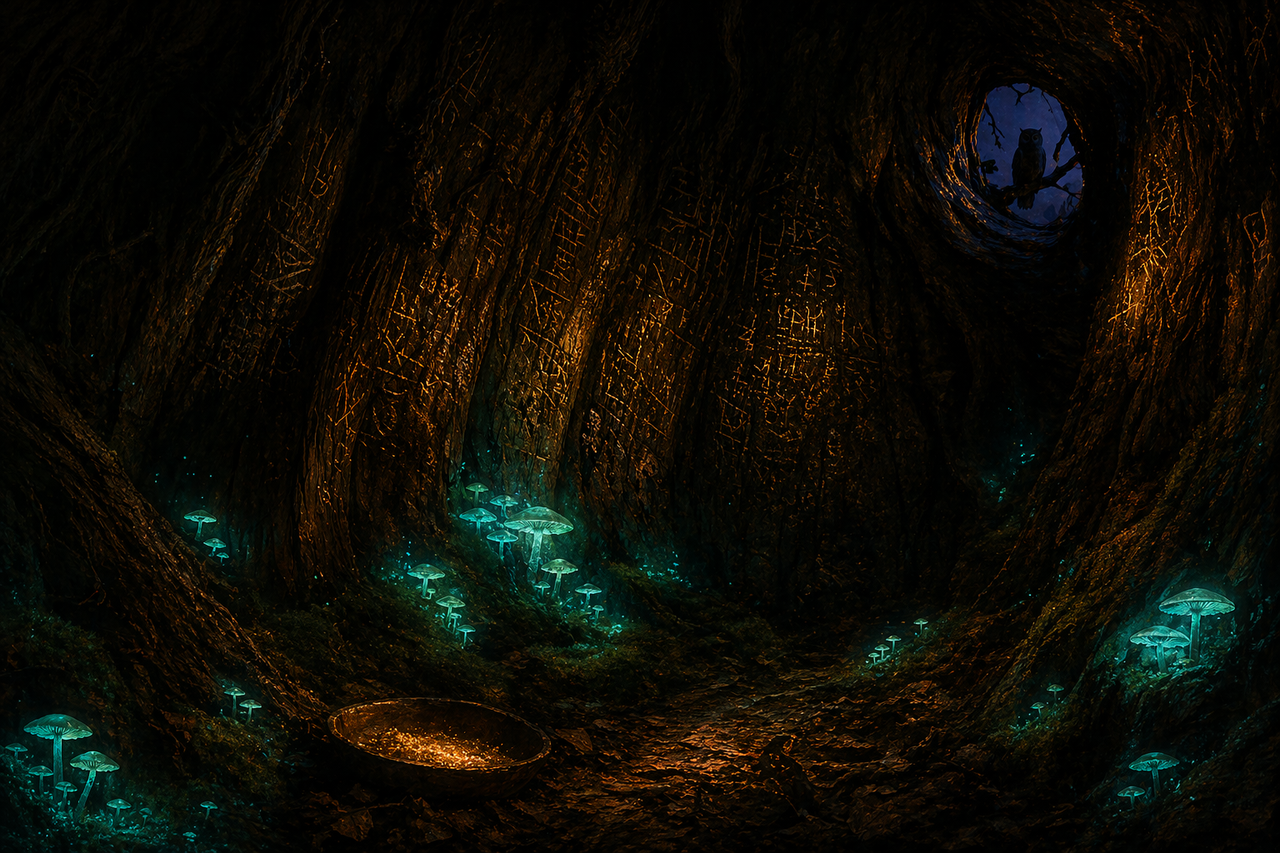
The light comes first. Not the herons. It arrives low and slanted through the pines, the kind of autumn light that makes you believe in geology, in the patient accumulation of sediment and time. The pond lies flat as hammered tin under it. A skin of algae has crept in from the eastern bank where the water grows shallow, and beneath that skin, invisible, the mud keeps its own counsel. They used to come in September. Then October. Last year, nothing. The blind stands empty on the north shore, its camouflage netting rotted to lace. Inside, someone has left a thermos, a field guide swollen with damp, three cigarette butts arranged in a triangle on the plywood floor. The pages of the guide have fused together. You could no more separate them than you could unweave fog. But the blind faces the wrong direction now. The pond has shifted. Not dramatically, not in any way you could point to and say, there, that is the change. But the water knows. It has redistributed itself by invisible degrees, responding to something beneath, some tilt in the underlying clay or limestone, some adjustment the earth is making without asking permission. The deep place where the herons used to fish has migrated fifteen feet southwest. The blind watches only reflection now, only sky. In town, they talk about it the way people talk about weather that has failed to break. Careful sentences. Observations cushioned in qualifiers. No one says the word gone. Instead: delayed, rerouted, disrupted. As if the herons were a train that might still arrive, merely late, merely inconvenienced by leaves on the line. The woman who owns the land walks the perimeter every morning. Her boots leave prints in the frost that linger until noon. She brings nothing with her. No binoculars, no notebook. She simply walks, and the walking is a kind of faithfulness, though to what she could not say. Sometimes she stops at the place where the old oak leans out over the water, its roots exposed like the bones of a hand. The tree is dying. Has been dying for a decade. But it dies so slowly that dying seems less like an ending than a state of being, a country the oak has taken up residence in. She was twelve when she saw her first heron. Felt, more than saw. The shock of it rising from the shallows, that impossible arrangement of angles and intention. The way it seemed to gather itself from the elements rather than disturb them. For years afterward, she measured time by their returns. Seasons were simply the spaces between. Now the pond waits. The quality of waiting has changed, though. It has thickened. In the shallows, the cattails have begun to propagate differently, sending their roots in patterns that look almost deliberate, almost like script. The muskrats have moved their lodges. The turtles surface less. Everything is rearranging itself around an absence that has not yet been named. At dusk, the mist comes. It rises from the water like an exhalation, like the pond breathing out what it has held all day. The boundary between water and air grows uncertain. This is when she sees them, sometimes. Not the herons themselves but their shapes, their possibility. The way the mist can organize itself into forms that are nearly wings, nearly the stretched parenthesis of a hunting neck. She knows better. She knows it is only vapor, only temperature and dew point conspiring. But knowing does not stop the heart from its leaping. Does not stop her from standing motionless on the bank, holding her breath, waiting for the mist to resolve into feathers, into the dark eye that sees through water. The light fails. The mist thickens. Somewhere in the middle distance, a branch cracks under its own weight and falls into water that receives it without sound. She will come back tomorrow. The pond will be here, patient as stone, remembering the shapes that used to break its surface.
Chapter 2
, by jmarsh
The branch floats now, turning slow circles in the current that should not exist, for the pond has no inlet worth naming, no stream to feed it but the rain and the seepage from the hillside springs. Yet the branch turns. Maura watches it from the bank (her name is Maura, and she has worn the same waxed canvas coat for sixteen years, its cuffs gone white with salt) and understands that the water is not as still as it pretends. Something beneath is moving. She kneels, her knees finding the cold mud, and lowers her hand to the surface. The water recoils. Not metaphorically. The surface tension breaks in a pattern that radiates outward from her fingertips, but wrong, the ripples moving inward first, collapsing toward the center of her touch before reversing themselves. She jerks her hand back. The pond settles. In the fading light, she can see her reflection and something else beneath it, deeper, a darkness that her eyes insist is only the silted bottom but her blood knows otherwise. Behind her, the oak groans. The sound is structural, the complaint of wood fibers compressed beyond their nature, and when she turns she sees what she has suspected for three weeks but refused to confirm: the trunk is splitting. A vertical seam has opened on the western face, wide enough now to admit a hand, and from within the gap comes a smell of iron and rot. Not the clean decay of autumn but something older, something that has been locked in the heartwood since before she was born. She stands. Her knees crack. The sound echoes across the water, or perhaps that is another branch falling, or perhaps the ice is forming early this year in the shallows where the cattails have begun to spell out their illegible messages. She walks to the tree and presses her palm against the bark beside the wound. The wood is warm. Impossibly warm, as if something inside is burning at a temperature too low to ignite, too high to ignore. The sun drops behind the western ridge. The pines blacken against a sky gone the color of old brass, and in that moment between day and night when the air holds its breath, she hears it: a call. Not the harsh croak of a heron but something underneath that sound, the structure that supports it, the way a bell's ring contains frequencies the ear cannot separate but the spine receives as truth. It comes from the pond's center, from the place where the deep water has migrated to. She turns. The mist is rising early, or perhaps it has been rising all along and she has only now noticed. It pours from the water like smoke from a fire that has finally found its draft, and within the rising column she sees them. Not shapes this time. Not possibilities. Bones. The architecture of wings without the flesh to clothe them, the segmented necks curved in attitudes of hunting, the skulls with their terrible beaks open on silence. They rise from the pond in a formation she recognizes, the V-shape they use for migration, but inverted, pointing down into the water rather than up into the sky. She counts six. Then nine. The mist keeps producing them, and they hang there, suspended between elements, more real than the tree behind her, more solid than the ground beneath her boots. She can see through them to the far shore but only barely, only as you might see through layers of old glass, each pane adding its own distortion until the view becomes a palimpsest of what is and what was and what is clawing its way back. The thermos in the blind begins to rattle. She hears it from a hundred yards away, the metal cap chattering against the metal mouth, and then the field guide's pages start to separate. Not torn. Not ripped. They simply remember their boundaries, the boundaries between pages that once were trees, and the trees remember their roots, and the roots remember the water that fed them, and the water remembers what it drowned. The skeletal herons begin to descend. Back toward the pond. Back into it. They sink without splash, without sound, and the mist swallows them like a throat closing around meat. Maura stands frozen, her hand still pressed to the oak's wound, and feels through the bark the thing inside beginning to push.
Chapter 3
, by typewriter_tom
The oak splits. The sound is a gunshot, a crack that sends crows exploding from the pines. Maura stumbles backward as the seam tears upward, the wound opening from root to branch, and from inside pours water. Not sap. Water, pond water, thick with algae and sediment, steaming in the cold air. It floods over the exposed roots and soaks into the ground, and where it touches the frost-hardened earth, things grow. Cattail shoots, fast as striking snakes. They puncture the soil in a dozen places, then a hundred, their brown heads already formed, already seeding. Maura backs toward the pond's edge, boots slipping in mud that wasn't there ten seconds ago. The cattails writhe upward, waist-high now, and they're spelling it again, that pattern she's been trying not to read for weeks. She sees it clearly now. Not words. Coordinates. Longitude and latitude, written in roots and stems, pointing to this exact spot where she stands. The water keeps coming. The oak is a fountain, a geyser, its trunk hollowed out and transformed into a pipe for something that has been waiting below. Below the pond. Below the clay. In the limestone that holds the whole valley like a cupped palm. She runs. Not away from the pond but along its shore, toward the blind. Her lungs burn. The mist has thickened into fog, and the fog has weight, resistance, like running through wet cotton. The blind materializes ahead, its camouflage netting hanging in shreds. She yanks open the plywood door. The thermos lies on its side, still rattling. The field guide sits open, its pages dry now, separating. She grabs it. The page it's fallen open to shows a illustration of a great blue heron, Ardea herodias, with anatomical labels pointing to wing structure, leg joints, the specialized vertebrae that allow the neck to strike. Someone has written in the margin in pencil, so faded she has to squint: "They go down first." Down. Not south. Down. Maura turns to the window cut in the blind's eastern wall. From here she can see the pond's center, where the mist churns above the deep water. The skeletal herons are rising again. But not skeletal anymore. As they emerge, flesh wraps around the bones like clay on an armature. Feathers sprout, gray and white and that particular blue that isn't quite blue, that color that belongs only to herons and winter ice and the space between storm and stars. They're rebuilding themselves. The pond is rebuilding them. She counts eleven. Eleven herons, fully formed now, solid, real. They circle above the water in that inverted V, still pointing downward, and their eyes are wrong. Not the yellow she remembers. Black. Entirely black, no pupil to distinguish, just obsidian spheres that reflect nothing. The first one lands. Not on the shore. On the water's surface, and the surface holds it. The heron stands on the pond like it's made of glass, and where its feet touch, the water freezes. Ice spreads outward in a perfect circle, white and thick. The second heron lands. Then the third. Each one adds another ring of ice, and the rings are expanding, reaching toward the shore where Maura stands watching from the blind. The thermos stops rattling. In the new silence, she hears something else. A voice. Human. Calling from across the pond, from the direction of the old cart path that leads back to the village. A man's voice, cracked with age or fear or both. "Maura! Get away from there!" She knows that voice. Glen Hardesty, who helped her father build this blind thirty years ago, who stopped coming to the pond the same year the herons stopped arriving. She turns, searching for him in the fog. "They're not back," he shouts, closer now, crashing through underbrush. "They never left. We just stopped seeing them right." The ice reaches the shore. It climbs onto land, crawling up the mud, up the cattails that bend and crack under its weight. Maura backs out of the blind as the ice finds it, starts coating the plywood walls. Through the eastern window, she sees the herons standing motionless on their frozen platform, eleven black-eyed sentinels, their beaks pointed down at the water beneath the ice. Glen breaks through the fog, breathing hard, and grabs her arm. "Run," he says. "Before they open it.
Chapter 4
, by Lior Tannen
Glen's hand on her arm is the only warm thing in the world. His fingers shake, knuckles swollen with arthritis, and Maura can feel his pulse through the threadbare sleeve of her coat. She doesn't run. "Open what?" she says. He pulls harder. Behind them, the ice makes a sound like singing, a high crystalline note that she feels in her back teeth. Glen's face is gray, stubbled with three days of growth, and there's a cut above his left eyebrow that's scabbed but recent. "The seam," he says. "Between what's here and what's been waiting." She plants her feet. The mud sucks at her boots. "You knew. All this time, you knew what happened to them." Glen's hand drops. He looks past her at the frozen pond, at the eleven herons standing motionless on their platform of ice. His throat works. "I was here the night they went down. October third, eleven years ago. Your father was with me." The cold reaches her lungs. Her father drowned that November. Fell through ice on Becker's Pond, ten miles north. That's what they'd said. That's what everyone said. "He didn't fall," Glen says, reading her face. "He went looking. For a way to bring them back." On the pond, the herons lower their heads in unison. Their beaks touch the ice. Where they touch, cracks appear, spreading outward in perfect radial lines like the growth rings of a tree. The ice begins to glow from underneath, a pale green phosphorescence that Maura recognizes from summer nights, from the algae blooms that light up when you drag your hand through warm water. "We used to see it different," Glen says. His voice is quieter now, almost conversational, the way her grandmother used to talk about her husband five years after he died. "The pond, the herons, all of it. We thought they came here. Built their rookery in the dead elm on the far side, raised their young, moved on. Regular migration. But your father, he kept records. Counted them. Same eleven birds, every year. Never more, never less. Never any young." The cracks in the ice reach the shore. They climb the bank like veins, like roots, like the thin dark lines on the palms of her hands where she used to help her father clean fish, where the scales would lodge under her skin and work themselves out weeks later, little pieces of silver that she'd find on her pillow. "He figured it out the summer before they stopped coming," Glen continues. "They weren't migrating up. They were migrating through. Using the pond like a door." One of the herons shifts its weight. Its foot lifts from the ice, and beneath where it stood, water wells up, black and viscous. Not pond water. Something else. Something that doesn't reflect the sky. Maura's throat is dry. "Through to where?" "Below," Glen says. "To whatever's in the limestone. Whatever made the valley this shape, hollowed it out, left these ponds like fingerprints. Your father thought if he could follow them, if he could go down when they did, he'd understand. He'd see what they saw." The black water spreads. It pools on the ice, eating through it in slow circles, and the herons step delicately sideways to avoid it, their movements synchronized. Maura has seen this before. This careful dance. They do it in the shallows when they hunt, placing their feet to avoid disturbing the silt, to keep the water clear enough to see the flash of scales below. "Did he?" she asks. Her voice sounds distant. "Did he follow them?" Glen takes off his cap. Underneath, his hair is white, thin enough to see scalp. "He went in. I waited here, in the blind. Waited all night. He never came back up." The black water has formed a pool now, maybe ten feet across, perfectly circular. The herons ring it like numbers on a clock face. Their black eyes are fixed on Maura. All eleven of them, watching her with an attention that isn't quite animal, isn't quite human. "They're waiting," Glen says. "They've been waiting eleven years for someone to finish what he started." Maura's hand finds her pocket. Inside, she feels the shape of the thing she's carried every day since her father died: his watch. The waterproof one he wore fishing. They'd found it on the bank of Becker's Pond, still running, the second hand sweeping circles like a heron hunting. The black water ripples once. An invitation.
Chapter 5
, by Cora Lindgren
The watch in her pocket ticks against her thigh. She can feel it through the canvas, through the denim underneath, a rhythm that doesn't match her pulse. Glen is saying something else but his words slide past. The black water ripples again, and with it comes a smell: not rot, not algae, but mineral. Iron and salt and something deeper, like the inside of a cave that hasn't held air in ten thousand years. Her boots move before she decides to. Three steps toward the shore, mud releasing her with wet sucking sounds. Glen grabs for her shoulder and misses. "Maura, don't." But she's already at the edge where ice meets mud. Up close, the black water looks solid. Not frozen, but dense, thickened, like it's holding something suspended in it. She kneels. Her knee finds a stone and the pain is sharp and grounding. One of the herons shifts. The one closest to her, standing at what would be two o'clock if the pool were a clock face. It opens its beak. No sound comes out. Instead, the air pressure changes. Her ears pop, and suddenly she can hear things she couldn't before: Glen's breath rattling in his chest, the creak of ice expanding somewhere beneath the pond's surface, the whisper of feathers adjusting against the wind that isn't blowing. She pulls out the watch. It's silver, dented on one edge where her father dropped it against a boat cleat when she was nine. The crystal is scratched but not cracked. The second hand sweeps. Thirty-two seconds past whenever-it-is. She never wound it. It never stopped. "He left this on purpose," she says. Not a question. Glen's breathing gets closer. He's standing right behind her now. "He left everything on purpose. His wallet. His keys. His wedding ring on the kitchen table with a note that said 'back by morning.'" The watch is warm. Her hand is cold. The difference feels important. She leans forward and dips the watch into the black water. The surface tension holds for a second. Then breaks. The watch sinks, the leather band trailing behind it like a tail, and the black water swallows it without a ripple closing over the space where it entered. The herons move as one. Their heads snap up, necks extending, and they call. It's the sound she heard yesterday but full now, no longer muffled by distance or mist. It's not a bird sound. It's a door opening. It's bedrock splitting. It's the noise a bell would make if you rang it underwater, in the dark, in a place where water had weight and memory. The black pool begins to drain. Not outward, but downward, pouring into itself, and as it drains the ice around it cracks and collapses inward, falling into the hole that's opening. Maura can see down into it now. Not water below. Space. A shaft cut through limestone, walls smooth as glass, descending so far the darkness at the bottom has texture. At the bottom of the shaft, something glints. Silver. The watch. "Jesus Christ," Glen whispers. The herons step into the hole. One by one, they simply walk forward off the ice and into the vertical shaft, their wings folding, their bodies dropping. They don't fall so much as descend, controlled, deliberate, like they're walking down stairs only they can see. Eleven herons, disappearing into the earth. The last one pauses at the edge. It turns its head and looks directly at Maura with those black, lightless eyes. Then it spreads its wings. They span six feet, maybe more, and in the membrane between the primary feathers she sees something impossible: images. Her father's face. The blind as it looked thirty years ago. A map drawn in pencil on paper gone brown with age. The oak before it split, its leaves green and full. The heron folds its wings and drops. The hole remains. Maura can smell the mineral scent pouring out of it now, and underneath that, warmer: wet clay, old wood, the particular sweetness of deep springs. Her father's smell, the one he carried home after long days checking the irrigation channels in the state forest. Glen's hand finds her shoulder again. Gentler this time. "You don't have to," he says. The hole is maybe four feet across. Wide enough. The walls look climbable, if she's careful. If she doesn't look down. Her knees hurt. Her hands are numb. The watch is waiting. She sits on the edge and lets her legs dangle into the dark.
Chapter 6
, by inkwell_amy
Her boots scrape limestone. The walls are slick and cold, and her fingers find handholds that feel carved, deliberate. Not natural. She lowers herself six inches. A foot. Glen's face appears above her, a pale circle against the darker sky. He doesn't speak. His lips move like he's counting, or praying. The descent erases the world in layers. First the pond, then the sky, then Glen. The circle of light at the top shrinks to a quarter, a dime, a nail head. Her breath echoes off stone. Her shoulders brush both walls. The shaft is narrowing. Twenty feet down, her boot finds the first body. Not soft. Not rotten. Solid, cold, familiar. She freezes, every muscle locked. Her right foot rests on something that gives slightly under her weight, something with contours. A shoulder. Buttons. She knows those buttons. Her hand releases the wall and reaches down, fingers finding rough wool, finding the shape underneath. She climbs past it. Keeps moving. Her throat is closed, her eyes burning, but her hands know the work. Find hold. Test weight. Descend. Her father taught her this. How to climb down into the county's old grain silos for inspections, how to trust stone, how to let your body think when your mind won't. Fifty feet. The walls weep water. It runs down her wrists, inside her sleeves, cold enough to ache. The watch is ticking somewhere below. She can hear it now, or thinks she can, the sound bouncing up the shaft like sonar. Her boot hits water. She jerks back, finds a foothold, stops. The water is ankle deep here, flowing across the shaft floor and disappearing into cracks in the stone. Not black anymore. Clear. She can see the bottom through it, see pale gravel, see something moving. Not fish. Too angular, too purposeful. She steps down. The water is ice, fire, every nerve ending reporting damage. She stands in it, waist deep in the shaft that's opened into a horizontal tunnel. The ceiling is lower here, maybe five feet. She has to duck. The watch gleams on the tunnel floor, ten feet ahead. Face up, second hand still sweeping. The leather band has curled in on itself. She wades toward it. Behind her, the shaft opening glows faint gray. Ahead, darkness with texture, with depth. Her hands are out in front of her, feeling for walls, for obstacles. The water gets deeper. Chest deep. The cold is taking her thoughts, grinding them down to simple words. Forward. Father. Find. The watch. She reaches it, crouches, water to her chin now. Her fingers close around metal and leather. The ticking stops. The tunnel floods with light. Not electric light. Not daylight. Green, phosphorescent, coming from the walls themselves, from veins in the limestone that pulse like arteries. She can see now. The tunnel stretches ahead fifty yards and opens into a chamber. The chamber has occupants. The herons stand in water that comes to their knees. All eleven, spaced in that same circular formation, facing inward. And at the center, rising from the pool, is a structure. Not stone. Not wood. Bone. Massive ribs arching overhead, forming a cage or a cathedral or something older than names. The ribs are gray-white, thick as tree trunks, and they curve down to meet at a central point beneath the water. She wades forward. The herons don't move. Their black eyes watch her approach, and she can see now what she couldn't see above: they're translucent. Light passes through them, through feather and flesh, showing the architecture underneath. Showing what they really are. Vessels. Containers. The herons are only the shape, the form that lets something else move between this place and the world above. She enters the circle. The bone structure towers over her, and she sees what the ribs are protecting. A pool within the pool, water so dark it looks like an entrance. Like an eye. And at its edge, sitting on a flat shelf of stone, is a pile of objects. Glasses. A hammer. A child's shoe. A tobacco tin. A wedding ring. Things left behind by people who came down and didn't go back. Her father's wallet sits on top, leather swollen with damp. She reaches for it. The herons open their beaks. The water beneath her begins to drain.
Chapter 7
, by Ruth Ann Keller
One does not grasp the wallet so much as accept it. The leather has gone soft, nearly liquid, and when Maura lifts it clear of the stone the water inside pours out in a stream that smells of nothing at all. No rot, no age. Merely water that has forgotten how to carry scent. The draining intensifies. Not gradual. The pool descends in visible increments, dropping six inches while she draws breath, another six while she exhales. The bone ribs above her head begin to emit sound. A low frequency one feels in the sternum rather than hears. The herons remain motionless, their translucent forms flickering now like lanterns in wind. She opens the wallet. The driver's license sits in its plastic window, her father's face looking out at her with an expression she had forgotten: patient, waiting, as though he had known even then that someone would eventually stand here holding this square of laminated paper. Behind the license, tucked into the billfold section, is a photograph. Not of her. Not of her mother. The image shows this chamber, this precise arrangement of bone and water, but different. The pool is fuller. The ribs arch higher. And standing where Maura now stands, knee-deep in receding water, is a woman in a dress from another century, 1890 perhaps, her hair pinned beneath a hat that has gone out of fashion. The woman's hand rests on one of the bone ribs. Her face is turned toward the camera with an expression Maura recognizes: determination, terror, wonder, all held carefully separate so that none might overwhelm the others. The water drops below her knees. Below her ankles. The stone shelf where the objects rest becomes an island, and Maura sees that more items lie beneath where the water stood. Dozens. A pocket watch that is not her father's. A compass. A hunting knife with a staghorn handle. A leather journal swollen to twice its natural thickness. She takes the journal. The cover adheres to itself. She works her thumbnail into the seam and pries gently. The pages separate with a sound like fabric tearing. The handwriting inside is not her father's. Too ornate, too careful. The ink has bled but remains legible. "June 14, 1889. Descend complete. The structure is as Samuel described, though larger. The herons wait. They have always waited. It is not we who have discovered them but they who have permitted us to arrive." Maura turns the page. The next entry is dated three months later. "September 9. The water rises and falls by no schedule I can discern. When it falls entirely, the pool at center becomes a passage. Margaret went through yesterday. She has not returned. I shall wait one more day before following." The herons shift their weight. All eleven, synchronized. Where their feet meet stone, frost forms in delicate patterns. Another page. Different handwriting now, smaller, masculine. "October 1931. Found Chambers' journal on the shelf. Found Chambers twenty feet down the passage, perfectly preserved. He is not dead. His chest moves once per hour. I do not know what to, " The entry ends mid-sentence. The water has drained completely. The pool at center is empty now, and Maura can see that it is indeed a passage. A vertical shaft, narrower than the one she descended, dropping into darkness that her eyes refuse to measure. Around its rim, carved into the stone in letters so worn she must trace them with her fingers to read, are words. Latin. Her father taught her enough to recognize the language if not the precise meaning. "Terminus," she makes out. "Porta." End. Door. The bone structure shudders. A vibration that begins in the ribs and travels downward, and where it enters the stone the limestone cracks. Hairline fractures spreading outward like roots. One of the herons steps forward. It walks to the edge of the central shaft and stops, its black eyes fixed on Maura. When it opens its beak, her father's voice emerges. Not his words. His voice, the particular timber and grain of it, but speaking syllables she does not recognize. Old syllables, shaped wrong for human mouths. The other herons join in. Eleven voices, none of them heron calls. Her grandmother's alto. Glen's rasp. The woman from the photograph. Voices belonging to every person who came down and did not return, all speaking in unison, all saying the same incomprehensible thing. The first heron steps into the shaft. Its wings open as it falls, and where it disappears a light blooms. Green, then gold, then colors for which Maura has no names. The others follow.
Chapter 8
, by Iris Beddoe
The colors remain after the herons are gone. Maura stands at the rim of the shaft where her father's voice has just been. The light pulses below. Not steady. Breathing. She sets the journal down on the stone shelf beside the compass, the knife, the watch that is not her father's. Her hands are shaking. Have been shaking since Glen said he went looking. Since the oak split. Since longer, maybe. Since the first morning she walked the pond's perimeter and felt the waiting in it. The wallet goes in her left pocket. Still dripping. The water soaks through to her thigh. Her father's watch goes in her right, leather band coiled like a question mark. Above her the bone ribs crack again. Wider this time. Through the fissures, something presses. Dark. Massed. The size of it unguessable because her eyes refuse the geometry. She knows what she is supposed to do. The herons showed her. The journal told her. Every object on this shelf is a breadcrumb, a trail that only leads one direction. Down. But. Her boot finds the shaft's edge. The stone here is warm. Warmer than the bones, warmer than the water was. She kneels and touches the carved words, lets her fingers rest in the groove of terminus. End. Not passage. Not doorway. End. The light below flares. In it, she sees. Not her father. Not the woman from 1889. Something older, something that wears the shape of herons the way she wears her father's coat. Convenient. Familiar. Wrong for the body underneath. She sits back. Her tailbone meets stone. "No," she says. The word is small in the bone chamber. It doesn't echo. The ribs shudder. The thing behind them pushes harder, and a chunk of bone the size of her head breaks free. It hits the floor and shatters. Where it breaks, the pieces twitch. Still moving. Still wanting. Maura stands. Turns. Walks back toward the tunnel. Behind her, something howls. Not sound. Pressure. The air collapses inward, trying to drag her back, and she leans into it. One step. Another. Her legs are lead. Her chest is concrete. The bone chamber doesn't want her to leave. She reaches the tunnel mouth. The water has drained from here too, leaving only wet stone, only her boot prints in silt going the wrong direction. She follows them backward. Toward the shaft. Toward Glen. Toward the pond. The howling intensifies. It has texture now, has syllables. Her name in her father's voice. Her name in her grandmother's. Come back, come back, finish it. She climbs. Her hands find the holds she used descending. They're slicker now, coated in something that wasn't there before. She doesn't look at it. Doesn't look down. Twenty feet. Thirty. She passes her father's body. This time she stops. He's wedged into an alcove she didn't notice on the way down, his back against stone, his face turned toward the shaft's center. His eyes are closed. His chest doesn't move. But his skin has no color of death. No gray, no wax. He looks like he's sleeping in the chair by the woodstove, waiting for the coffee to finish. She reaches out. Touches his hand. Cold. But not corpse cold. Stone cold. "I'm sorry," she whispers. "I can't." His eyes open. Black. Entirely black, like the herons'. Like the water in the pool. He smiles at her with her father's mouth and behind the smile is the thing that wants out, the thing the herons carried up and down for centuries, the thing the pond was made to hold. She jerks her hand back. Keeps climbing. His voice follows her up the shaft. Not howling now. Reasoning. We could go together. I could show you. It's beautiful down there, Maura. It's where everything starts. The circle of light above grows. Fifty feet. Forty. Her arms are screaming. Her fingers are bleeding. Glen's face appears at the rim. His hand reaches down. She takes it. He hauls her up and they collapse together on the ice, gasping, and the ice is melting now, breaking apart, the pond returning to itself. Behind them the hole begins to close. Stone grinding over stone. Sealing. Her father's voice cuts off mid-word. The pond goes still. Maura lies on her back, Glen's hand still gripping hers, and watches the sky go from brass to gray to the particular blue that means morning soon. The herons don't return.
· end ·