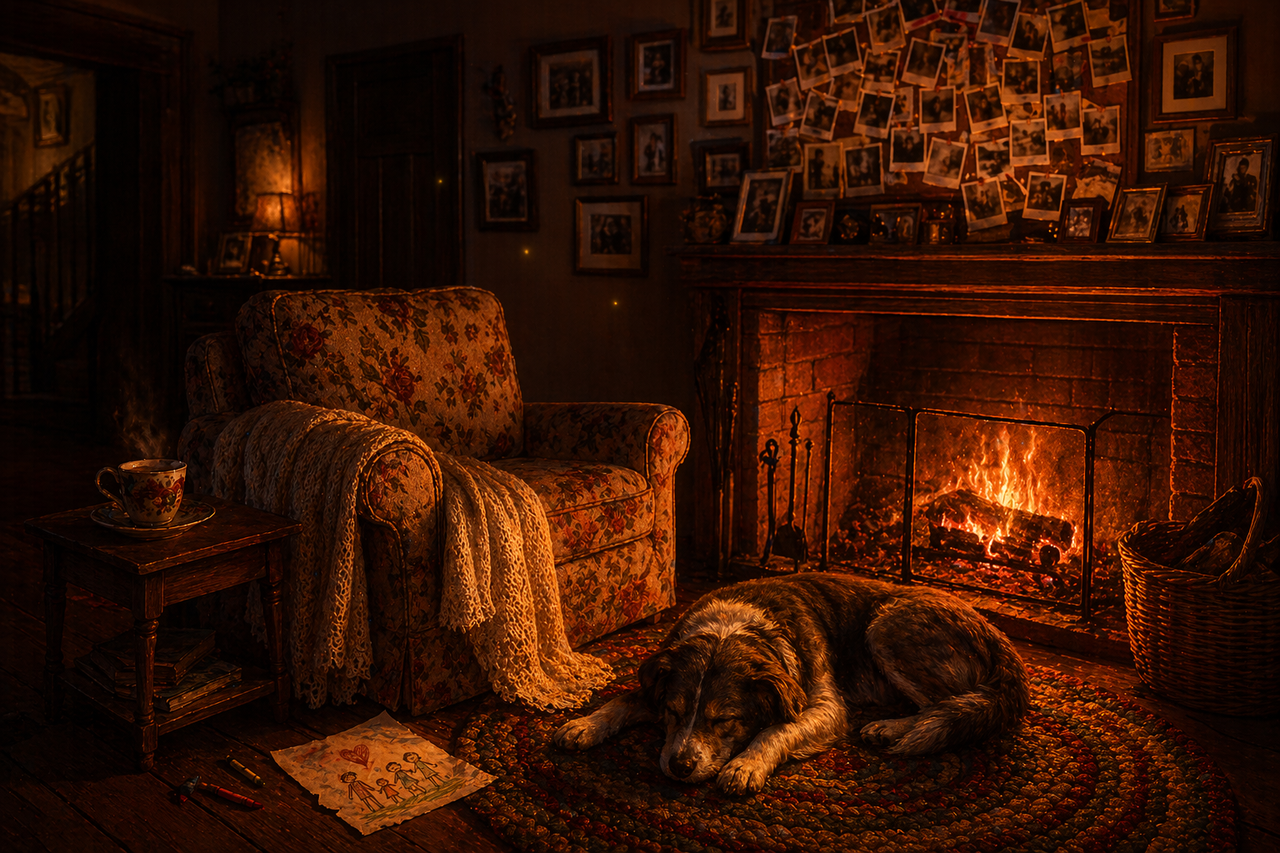
FAMILY · 8 chapters · eight strangers
The Breath Still Trapped in Folds
Chapter 1
, by wordsbylena
The table measures eight feet three inches, walnut veneer over particle board, manufactured in Grand Rapids between 1974 and 1976 based on the stamp beneath. Fourteen visible water rings on the surface. Two cigarette burns near the far left corner. One long scratch running diagonally, approximately nineteen inches, origin unknown. Six chairs remain of the original eight. Two disappeared in 1989 during the move from Dearborn. The chairs that stayed: maple frames, vinyl seats in burnt orange, three with intact cushions, three with splits exposing yellow foam. Total splits counted: seven major, eleven minor. Mother sits in the second chair from the east end. Has sat there for thirty-two years, four months, six days. Her plate contains three items, always three: protein, starch, vegetable. Today the protein is meatloaf, four ounces, one corner piece, cooked seventeen minutes past optimal. The starch is potato, mashed, with exactly two pats of butter forming eyes in the crater she makes with her spoon. The vegetable is green beans, canned, Del Monte brand, drained weight nine ounces distributed among four plates, her portion 2.25 ounces, containing approximately forty-three beans. She counts them. I know because her lips move. One, two, three, pause. Four, five, six, pause. A rhythm established in childhood, maintained through marriage, divorce, remarriage, widowhood. The counting never stops. Father's chair sits empty, third from the west end. Has been empty for two thousand, one hundred and seventeen days. No one sits there. No one moves it. A placemat remains, blue cloth with white anchors, twelve anchors total, arranged in a border pattern. Sometimes Mother sets a glass of water there. Sometimes the glass evaporates over days, leaving a new ring, number fifteen, sixteen, seventeen. I have stopped tracking the new ones. My brother takes the west end. He arrives at 6:47 PM, three minutes later than yesterday, eleven minutes later than his average over the past ninety days. He carries his phone in his left hand, checks it four times before sitting, eight times during the meal, three times between bites. His fork touches his plate seventy-two times. He eats in sets of three: three bites, sip of water, three bites, check phone, three bites, sip of water. A pattern he does not know he has. I occupy the east end, facing him across eight feet three inches of scarred walnut. Between us: Mother in her chair, Father's absence, two empty seats where sisters once sat. The sisters left in 2003 and 2007 respectively. Their chairs have been loaned to guests on four occasions, reclaimed within hours of the guests' departures. The meal contains seventeen minutes of eating, eleven minutes of silence, four minutes of conversation. Mother speaks three sentences. My brother speaks five. I speak two, both answers to direct questions. We do not discuss Father. We do not discuss the sisters. We do not discuss why we continue gathering at this table, in this configuration, enacting this geometry of absence. After dinner, I count the dishes. Four plates used, three washed, one scraped and stacked for tomorrow because Mother always saves the meatloaf plate. It has been the meatloaf plate for six years. Before that, the chicken plate for eight years. Before that, the pot roast plate for four years. The plate itself is eighteen years old, part of a set of twelve, eight broken, four remaining. In the kitchen drawer: forty-three forks, twenty-seven knives, thirty-eight spoons. I count them weekly. The numbers change without explanation. Utensils appear, disappear, reappear in different slots. I have kept records for nine years, two months, fourteen days. Composition notebooks, college-ruled, seventy pages each, twenty-three notebooks filled and stored in my closet in chronological order. Each meal documented. Each word spoken, transcribed. Each pattern noted, measured, compared against previous occurrences. My brother thinks I am compiling data for a project. Mother thinks I am writing a book. Neither asks to see the notebooks. Neither wants to know what the numbers reveal about us, about this table, about what we have become in the spaces between meals. Tonight I record: Meal number 3,347. Participants: three. Empty chairs: three. Words spoken: ten. Silences: unmeasurable. The truth accumulating in figures I cannot stop collecting, in patterns I cannot stop seeing, in the space where a family used to be.
Chapter 2
, by Dan Okafor
The thing about Carl is he never actually looks at his phone. He holds it, touches it, the screen lights up his face in that blue-dead way, but his eyes don't focus. I timed it once. Average glance duration: 0.8 seconds. Not enough to read a text. Barely enough to register that the screen is on. I haven't mentioned this in the notebooks. There are things the notebooks don't get. The smell of the meatloaf plate, for instance, which has absorbed six years of Thursday dinners and gives off a burnt-sweet smell even after washing. The way Mother's breath catches before she speaks, this tiny hitch like she's surprised to find herself with something to say. The sound of Carl's wedding ring tapping the phone case. Tap tap, pause, tap tap tap. He doesn't know he does this either. His wife left in March. He told us in May, sentence number four of that evening's allotment: "Jennifer moved to her sister's place." Mother said, "Oh." I said, "I'm sorry." He said, "It's fine," which wasn't one of the five sentences but I didn't count it because his mouth was full. He still wears the ring. I don't wear mine anymore, but then again, mine was a different situation. Sophie didn't leave. Sophie evaporated, which is what I call it in my head because one day she was there and the next day she wasn't, and in between there were no suitcases, no arguments, no final conversations. Just a note on the table. Not this table. The table at our apartment, IKEA pine, cheap and temporary. The note said: "I can't watch you do this anymore." I still don't know what "this" was. That was four years ago. Meal number 1,891, to be precise. Mother keeps Sophie's glass in the cabinet, the one with the thin blue line around the rim. I've never seen her use it. It just sits there between the everyday glasses and the wine glasses nobody drinks from. Once I tried to use it and Mother's hand shot out like I'd reached for something burning. She didn't say anything. Didn't have to. There are seventeen items in this house that belonged to Father. I know because I counted them during the memorial, while everyone else was crying or not crying in their various ways. Seventeen seems low for a man who lived here thirty-nine years. His razor. His coffee mug with the chip in the handle. Eleven books on the shelf in the den, mostly Michener, one Clavell. His reading glasses in the drawer by his chair. The placemat. And the wedding photo on the mantel, though technically that belongs to both of them, so maybe it's sixteen and a half. Carl doesn't know I count these things. He thinks I count the utilitarian stuff, the forks and beans and water rings. Thinks it's some weird organizational habit, maybe OCD, maybe spectrum-related. He looked it up once; I saw the search history on his laptop when I borrowed it. "Why does my brother count everything." "Compulsive counting disorder." "Is counting a sign of autism." I'm not autistic. I'm just paying attention. Mother finishes her beans, all forty-three. Folds her napkin into quarters, then eighths, then sixteenths. This is new. The folding used to stop at quarters. I note the change without writing it down, add it to the list of things that exist outside the notebooks, the things that would make the pattern mean something if I let them. "Your father liked the corner pieces," Mother says. Sentence number four, off schedule. We've already hit our conversation quota for the evening. Carl's phone lights up. Tap tap. His eyes don't move. I count the seconds until someone speaks again.
Chapter 3
, by Iris Beddoe
The accordion takes up two chairs. It arrived in Father's hands, 1981. Scarlet red with pearl buttons. Hohner Corona, thirty-one treble buttons, twelve bass. He played it exactly once, during meal number unknown, before I started counting. Carl was four. I was seven. The sisters, both still here, were nine and eleven. He played something Polish, something his father played, something that made Mother put down her fork at the mashed potato stage. The music lasted ninety seconds. Maybe less. When he finished, he set the accordion on sister-one's chair. Said: "That's how it goes." Sister-one, standing, holding her plate. Learning to accommodate. It has occupied the chair ever since. Forty-two years. Sister-one found other places to sit. Then found other places to live. No one has opened the bellows since Father's hands left them. The pearl buttons have dulled. Dust in the pleats. A smell like old breath trapped in the folds. Mother dusts around it. Not it. Sets placemats on either side. The accordion gets no placemat, no glass of water, no forty-three green beans. Just space. Just the permanent fact of itself. Carl asked once, meal number 1,670-something, why we keep it. Mother said: "It's not hurting anyone." Which wasn't an answer but we pretended it was. Sometimes I think the accordion is breathing. The bellows expand in summer, contract in winter. Wood swelling, leather drying. Physical laws pretending to be something else. But at night, when I'm washing the meatloaf plate for the sixth year running, I hear it. A wheeze. An inhale that never reaches exhale. Sophie saw it her first time here. Meal number 430. She'd been warned about the empty chairs but not the occupied one. "Why is there an accordion?" she asked. Direct question. I gave a direct answer: "It was my father's." "Does anyone play it?" "No." "Then why, " Mother's breath-hitch. The conversation ended. Later, in the car, Sophie said: "Your family is like a museum where everything's alive but pretending not to be." I wrote that down. Not in the notebooks. On a receipt from the gas station, which I kept in my wallet until it disintegrated into white pulp. Carl's ring taps the phone case. Tap tap tap. The accordion sits between us, red fading to pink in the spots where sunlight hits. In the spots where Father's hands gripped: darker. Oil from skin, preserved. A map of holding on. Mother folds her napkin into thirty-seconds. I didn't know fabric could go that small. Her fingers are small too, smaller than last year. Meal number 3,290, I noticed her wedding ring spinning. Now it spins with every gesture. Gold circling bone. Another thing leaving by degrees. "He wanted to teach you boys," she says. Sentence five, six, seven. We've left the script entirely. "The accordion. He said every man should know an instrument." Carl's eyes stay on his phone-not-phone. But his hand stops tapping. "Why didn't he?" I ask. Mother smooths the impossible napkin. "He forgot how." This makes no sense. You don't forget music. You don't forget your hands. But Father's chair has been empty for two thousand one hundred and seventeen days, and in that time I've learned: forgetting isn't about memory. It's about deciding the past costs too much to carry. The accordion weighs nineteen pounds. I looked it up. Nineteen pounds of red lacquer and pearl buttons and trapped breath. Nineteen pounds of sister-one's missing chair. Nineteen pounds of a song played once and never repeated. Carl stands. Meal number 3,347 concludes at 7:34 PM, eight minutes early. He doesn't check his phone on the way out. Forgets it on the table, actually. Screen dark. For once, finally, dark. Mother and I, we sit with the accordion between us. The no-breath breathing. The red ghost of a man who knew one song and chose silence. I don't write this in the notebook. Some numbers refuse counting.
Chapter 4
, by Margot Vail
The phone stays where Carl left it. Mother looks at it. Doesn't touch it. The screen catches kitchen light, a black mirror reflecting the overhead fixture, forty watts, installed 1998. I could get it for him. Could call him back. Don't. "The drawer sticks," Mother says. Which drawer. The house contains twenty-three drawers I've catalogued. Kitchen: eleven. Dining hutch: four. Sideboard: two. Den desk: six. But she's looking at the table, so not those. The table has one drawer. Center-mounted, brass pull worn to copper where thumbs press. "Always has," she says. I've opened that drawer six times in nine years. Contents never change. Or didn't. Napkin rings, silver plate, tarnished. A candle stub. Instruction manual for a hand mixer, Sunbeam, model unknown. Rubber bands in a knot too tight to separate. Birthday candles, the thin kind, maybe thirty. A corkscrew. A child's crayon drawing, folded in quarters, never unfolded in my presence. Mother's hands rest on the table edge. The ring spins once. She doesn't push her chair back. Doesn't stand. Just says: "You should look." At what. The drawer contains objects, inert, documented. Nothing requires looking. But her chin tips toward it, minimal gesture, and I understand this is sentence eight, nine, ten. This is the quota broken for a reason. I pull the brass handle. It sticks. Force required: more than expected. The drawer judders open four inches and stops. Something blocking it from inside. I pull harder. Six inches. The contents have shifted. The candle stub has rolled forward. The napkin rings are tilted. And behind them: an envelope. Not cream, not white. Yellow. Manila. The kind that contains documents, taxes, things official and final. My name on it. Ballpoint pen, blue ink, capitals. Block letters. Careful. I know every hand in this family. Mother's cursive, elaborate, loops like embroidery. Carl's scrawl, illegible, speed over form. Sister-one's architect precision, she went to school for that. Sister-two's slant, left-handed, smudged. Father's print, mechanical engineer's draft: each letter identical to the last. This is none of them. "Whose?" I ask. Mother folds her hands over the impossible napkin. "I don't know." Can't be true. She knows. The drawer is hers, the table is hers, the house is hers by inheritance and survival. Nothing enters without her allowing it. But her face gives nothing. The breath-hitch comes and goes. I take the envelope. Weight: minimal. Something inside but not thick. Paper, maybe three sheets. The flap is tucked, not sealed. No moisture, no glue. Opened before or never closed. Carl's phone buzzes on the table. Once, twice. We both ignore it. "When did you find this?" I ask. "I didn't." "Then who?" She looks at the accordion. Not at me, at it. The red catching lamplight, the pearl buttons like teeth. "It was there when I looked. This morning." This morning is Thursday. Thursday is meatloaf. The routine undisturbed for six years. Nothing changes on Thursdays. But this morning Father had been dead for two thousand one hundred and seventeen days. And this morning was also the morning after Wednesday, and Wednesday Mother had gone to the lawyer. I know because she told us, meal number 3,346, sentence two: "I signed the papers." What papers. Estate, probably. The house, the accounts, the물 divisions between children. Standard procedure. Expected. But the envelope has my name. Not Carl's, not the sisters'. Mine. I open it. Three sheets, as estimated. Paper: standard printer weight, twenty pounds. The text: typed. Not handwritten. Courier font, twelve point, single-spaced. A letter. The first line: "You've been counting the wrong things." My hands go still. The paper doesn't shake but my pulse does, I feel it in my thumbs where they press the edges. I read on. "The drawer has been opened forty-three times since your father died. You opened it six times. Your mother, twelve. Carl, once. The rest: someone you haven't counted." I look up. Mother is watching me now. Not the accordion. Me. "Who else has been here?" I ask. She spins the ring. "Read it." I do. The letter continues but the words rearrange as I take them in, facts I thought I knew unmade by facts I didn't.
Chapter 5
, by Sammy Hall
The letter says Carl comes on Tuesdays. Not just Thursdays. Tuesdays too. Has been for eight months. Sixteen visits I never logged because I'm only here for Thursday dinners, Thursday counts, Thursday documentation of our terrible little ritual. "That's not possible," I say. Mother tilts her head. Doesn't confirm, doesn't deny. Just that look she gets when you've said something true and stupid at the same time. The letter keeps going. "He brings takeout. Chinese, usually. Sits in your father's chair. They don't talk much but they're there together, which is more than you manage." My throat closes up. I read it again. Same words. "You knew?" I ask. "I invited him." Four words. Quiet. She picks up Carl's phone, holds it like it might bite. Sets it back down. I flip to the second page. The typing is perfect. No strikethroughs, no typos. Someone composed this carefully. Wanted precision. "The sisters call on Sundays. They don't ask about you. They ask if the accordion is still there, if the drawer still sticks, if she's still folding napkins. Your mother says yes, yes, yes. Then they talk about weather for six minutes and hang up." Sister-one is in Sacramento. Sister-two is in Portland. I know this the way I know the number of forks in the drawer, facts collected and filed. But I don't know their voices anymore. Wouldn't recognize them on the phone. Haven't tried. "How does someone know this?" I hold up the pages. "Who's watching us?" Mother stands. Finally. Her chair scrapes, a sound I've heard three thousand times but it still makes my teeth ache. She walks to the hutch, opens the top drawer. The one I catalogued as containing tablecloths, seasonal, four total. She pulls out a notebook. Not mine. Different brand. Spiral bound, green cover. She sets it on the table between the accordion and the meatloaf plate. "Sophie came back," Mother says. The room tilts. Doesn't, but feels like it. "When?" "Year ago. Little more." Meal number 3,080-something. I was here. Thursday count, Thursday meal. No Sophie. No extra chair pulled up, no glass with the blue rim. "She comes Saturdays," Mother says. "Helps with the garden. Fixes the porch step. Last month she repainted the shutters." The shutters are green. Were green. Are greener now, I guess. I thought the city did that. Thought maybe the homeowner's association sent someone. I open the green notebook. Sophie's handwriting. I'd know it in my sleep. Loose, quick, letters tumbling into each other. The opposite of my careful columns. First page: "He's counting but he's not seeing. Someone needs to track what he misses." I flip through. Dates, observations. Not meals. Life. "Tuesday, April 18th: Carl cried in the kitchen. She made him tea. He didn't drink it but he stopped crying." "Sunday, May 7th: Sister-one asked if he still comes for dinner. Voice very small. She misses him but doesn't know how to say it." Page after page. A whole year of Saturdays, of hours I wasn't here, of a family that kept happening without my documentation. The last entry is this morning. "Left the letter. He'll either understand or he won't. Either way, the counting has to mean something besides numbers." I close the notebook. My hands are shaking now, definitely shaking. "Why didn't you tell me?" Mother sits back down. The napkin is still folded into its impossible smallness. She picks it up, unfolds it. Quarters, halves, whole. Smooths it flat. "You stopped asking questions," she says. "Started just recording answers." The envelope has one more page. I don't want to read it. Read it anyway. "The funeral is Saturday. Your father's brother. You didn't know he existed because you never asked about the accordion, about where it came from, about who taught your father that one song. His name is Julian. He's been dying for six months. Everyone knows but you." I look at Mother. She nods. "Viewing is at ten," she says. "You'll come?" It's not really a question. Carl's phone buzzes again. This time I pick it up. Text from Jennifer: "Tell him I'm sorry. Tell him Tuesday is good." I don't understand. Don't understand any of this. But the drawer is open. The letter is real. And I've been counting for nine years without ever asking what the numbers were supposed to add up to.
Chapter 6
, by Cora Lindgren
The phone is warm in my palm. Body heat Carl left behind, or the battery working, something about the temperature makes my skin aware of itself. I set it down before I can decide whether to answer Jennifer, before I can parse what Tuesday means in a life I apparently know nothing about. The green notebook sits open. Sophie's handwriting sprawls across a page dated six weeks ago: "He touched the accordion today. Just the edge. Pulled his hand back like it burned him." I didn't touch it. I know I didn't. Unless I did and uncounted it. Filed it under gestures too small to document. Mother stands again, moves to the kitchen. Water runs. The meatloaf plate, getting its rinse even though I always do this part. She's disrupting the pattern. I should write that down. Don't. "Julian played polkas," she says over the running water. "Your father hated polkas. Learned one anyway because Julian was dying the first time, back in '81. Cancer then too. Took forty years to finish the job." The first time. Forty years ago. Father brought the accordion home and played a song for a brother who lived, who kept living, who's only now getting around to the actual funeral. I pull the accordion toward me. Heavier than nineteen pounds, turns out. Or my arms are weaker than I thought. The pearl buttons are cool, smooth. Someone has touched these recently. Oil from fingers, faint but there. Not forty-two years of dust. Fresh. "Carl plays," Mother says. She's drying the plate with the yellow towel, the one with the bleach stain shaped like Ohio. "Not well. But he sits there Tuesday nights and works through it. 'Beer Barrel Polka.' Same one your father knew." The bellows resist when I try to open them. Leather stiff, the folds stuck to themselves. I pull harder and air wheezes out, sour and old. A chord I didn't intend, minor and flat. The sound fills the room, bigger than it should be. Fills my chest too, vibration traveling through my hands. "Sophie taught him," Mother says. "Her grandfather played accordion. She remembered enough to get Carl started." I close the bellows. The air sighs back in. My fingers find the buttons, three in a row. Press. Nothing, because the bellows are shut. Instrument needs breath to make sound. Needs the in-and-out. "You want me to go to this funeral," I say. "I want you to stop counting and start looking." She folds the towel in half, in half again. Hangs it on the oven door handle where it's hung for sixteen years. "Julian asked about you. Last month, when I visited. Asked if you were still taking inventory." "You visited." "Wednesdays. He's in hospice over on Maple. The place with the blue roof." I drive past there every Thursday. Have driven past it one hundred and fifty-six times if I've been coming for three years. Never wondered who was inside, dying in rooms I couldn't count. The third page of the letter has one more line. I missed it before, small type at the bottom: "The drawer has one more thing in it. Under the crayon drawing. You'll need it Saturday." I pull the drawer fully open. It screams against the runners. The instruction manual slides forward. The napkin rings scatter. I lift the crayon drawing, unfold it for the first time. Two stick figures. One big, one small. Both holding something red between them. Not a ball. Too square. The child who drew this, maybe me, maybe Carl, made it rectangular. Made it important. The accordion, obviously. The accordion between two people, both touching it. Under the drawing: a photograph. Three by five, color faded to yellow. Two men standing in a kitchen. Not this kitchen. Somewhere older, linoleum floor, metal cabinets. Both men holding the same red accordion. The one on the left is Father, young, maybe twenty. The one on the right looks exactly like him, but softer in the face. Julian. They're both smiling. I've never seen Father smile like that. Open-mouthed, head tilted back. Joy or laughter, some feeling that didn't make it to my childhood, my three thousand counted meals. Mother stands behind me. Her hand rests on my shoulder, light. The ring is loose enough it shifts when her fingers press. "Saturday," she says. "Ten o'clock. Wear something nice." I slide the photograph into my shirt pocket. Against my ribs. Right where the heartbeat is.
Chapter 7
, by Dario Selo
The photograph sits against my ribs and what I'm thinking is this: the body keeps count too, in ways I never made columns for. Pulse rate, breath depth, the particular weight of evidence pressed to skin. Four days until Saturday (ninety-six hours, five thousand seven hundred sixty seconds, but who's calculating). What happens when you arrive at a funeral of a man you didn't know existed, carrying proof that he existed more fully than you did, that his smile contained multitudes while yours contained only the careful cataloging of absences? Mother's hand lifts from my shoulder. The ring catches light as she moves away. I should inventory this moment: the temperature of her palm lingering, the smell of dish soap, the specific quality of silence that follows a confession. But what I'm doing instead is trying to remember the last time I touched someone on purpose (not counting handshakes, which are contractual, not counting the accidental brush of bodies in grocery aisles, which means nothing). Sophie used to sleep with her hand on my chest. Right where the photograph is now. I'd lie awake counting her breaths, syncing them to mine, finding ratios. Three of hers to two of mine. A pattern I could hold onto when everything else seemed deliberately chaotic. "You're doing it again," Mother says. Doing what. I'm standing here. Hands on the accordion. Photograph against my heartbeat. Perfectly still. "The face," she says. "The one where you're adding something up." Carl does this thing where he pretends to look at his phone, and I do this thing where I pretend I'm present while actually I'm somewhere else, some distant country where everything makes sense because everything reduces to data. How do you apologize for that. How do you say: I'm sorry I turned you all into numbers because numbers don't leave, don't die, don't require me to feel anything except the satisfaction of a column summed correctly. The accordion is still in my hands. I should put it back. Return it to sister-one's chair, to its forty-two years of vigil. Instead I'm holding it, and what surprises me is this: it feels like holding something alive. Not metaphorically alive. Actually alive. The leather warm now from my palms, the wood vibrating slightly (the house settling, the refrigerator humming, physical explanations for everything), but still. "He wanted you to have it," Mother says. "Julian. He told me last Wednesday. Said your father promised it to you, or would have, if he'd known how to say things directly." My father, who sat three chairs down for thirty-nine years and spoke in careful ratios (three sentences per meal, two on good days, one when the silence was too expensive to break). My father, who played one song once and then stopped, as if music were a limited resource he'd exhausted in ninety seconds. I pull the bellows open. This time deliberately. The wheeze becomes a chord, something almost major. My thumb finds a button. Presses. B-flat, unless I'm wrong, unless the accordion is too old to be in tune. The sound is reedy, insistent. Loud enough that it should wake something. Carl's phone buzzes. I pick it up (seven texts now, all from Jennifer, unread because they're not mine to read, except maybe they are, maybe privacy is just another way of keeping count of what we're allowed to know). Mother watches me not open them. "Tuesday," I say. "Carl comes on Tuesdays." "Yes." "And the sisters call on Sundays." "Yes." "And Sophie comes on Saturdays." "Yes." "And I come on Thursdays and write everything down except the things that matter." Mother picks up the green notebook. Sophie's chronicle of what I missed. A whole separate accounting. She holds it out to me. "Take it," she says. "Read what she saw." I take it. The notebook is lighter than mine (fewer pages, less data, or maybe just less need to prove something through accumulation). What I want to ask is: did Sophie leave because she couldn't watch me count anymore, or because she was counting too and couldn't stand the total we were reaching. What the letter said. "I can't watch you do this anymore." This being: the reduction of life to inventory, the refusal to let anything mean more than its measurable components. Saturday. Julian's funeral. A man I never met who kept living just long enough to make sure I got an accordion I don't know how to play. Four days. Mother sits back in her chair, the one she's occupied for thirty-two years, four months, six days (old habits, old counts). She's waiting for me to decide something.
Chapter 8
, by Priya Nair
I decide to put the accordion on the floor. Not back on the chair. Not some symbolic reconciliation between object and furniture. Just down. On the cracked linoleum near the table leg that's half an inch shorter than the others (I shimmed it once with a folded index card, four years ago, meal number 1,653, the card is still there). Mother watches this like I've set something on fire. "What are you doing?" she asks. "Making room." For what? I don't know yet. But sister-one's chair is empty now, genuinely empty, for the first time since 1981. Looks smaller without the accordion. Looks like it might fit a human person. I pull out my phone. Not to count. To dial. Sister-one answers on the third ring. "Who died?" "No one yet," I say. "Saturday though. Uncle Julian. You coming?" Silence. Then: "We didn't know he existed." "Neither did I until twenty minutes ago. Mom's been visiting him on Wednesdays. Apparently we have a whole other schedule going that I've been missing." "You're using your weird voice." "What weird voice?" "The one where you're trying to sound normal but you're actually having a feeling." I look at Mother. She's doing the napkin thing again, folding it down into quantum dimensions. "Can you come or not?" I ask. "Is the accordion still there?" I look down at it. The red case catching overhead light, the pearl buttons like a closed mouth. "Not on your chair," I say. Another silence. Longer. I hear traffic in the background, a horn, someone shouting about parking. Sacramento sounds. "I'll call Sarah," sister-one says. Sister-two. Portland. "We'll get flights." "There's a chair here," I say. "Two chairs actually. Yours and hers. In case that matters." "It matters." She hangs up. No goodbye, which is genetic probably, Father's side, the inability to end things properly. I put the phone down. Pick up Carl's. Text Jennifer back, just three words: "He says Tuesday." The reply comes in five seconds: "Thank you. Really." Then another one: "Tell him I'm bringing pierogi." I will not tell him that. He can be surprised. People should get surprised sometimes instead of having everything pre-counted and logged. Mother unfolds the napkin. All the way. Spreads it flat. "You didn't ask me if you could invite them," she says. "You didn't ask me if you could visit Julian." "Fair enough." I sit in Father's chair. Just sit. It's been two thousand one hundred seventeen days and I've walked past this chair roughly three thousand times and never once considered the possibility that it was just a chair, that the absence didn't have weight, that occupying it wouldn't cause some cosmic collapse. It's a chair. The vinyl is cracked. There's a spring that pokes up on the left side. It smells like Old Spice even though Father's been dead for six years, which means Mother has been doing something to keep that smell, spraying it maybe, maintaining the ghost deliberately. "You spray this," I say. "Thursdays," she says. "Before you arrive." Of course. The one day I show up, she prepares the museum. The other days? Maybe the house is different. Maybe it breathes. Sophie's notebook is still in my hand. I open it to a random page: "August 14th: She laughed today. Real one, not the polite kind. Carl told a story about Jennifer's mother and the Costco samples and she laughed so hard she had to sit down. I'd forgotten what her laugh sounds like. Low and surprised, like she's startled by her own joy." I look at Mother. "You laugh on Tuesdays?" "Sometimes Carl is funny." "He's never funny on Thursdays." "Different audience," she says. The accordion sits on the floor between us. The bellows are still slightly open from when I played the B-flat, or whatever it was. Air trapped mid-breath. "I don't know how to do this," I say. "Do what?" "Stop counting. Or count different. Or whatever Sophie wants, whatever you want, whatever Julian wanted before he became a person I'm supposed to mourn." Mother stands. Walks to where I'm sitting in Father's chair. Puts her hand on my head like I'm eight years old, like the numbers haven't accumulated into years I can't take back. "Saturday," she says. "Ten o'clock. We'll figure out the rest after." The ring spins on her finger. I reach up, stop it. Hold her hand still. "Okay," I say. She squeezes once. Lets go. The photograph is still against my ribs. The accordion is still on the floor. Carl's phone is quiet. And somewhere in Sacramento and Portland, my sisters are booking flights to a funeral that might actually be a homecoming, might actually be the first true thing we've done in six years. I pick up the accordion. Time to learn that song.
· end ·