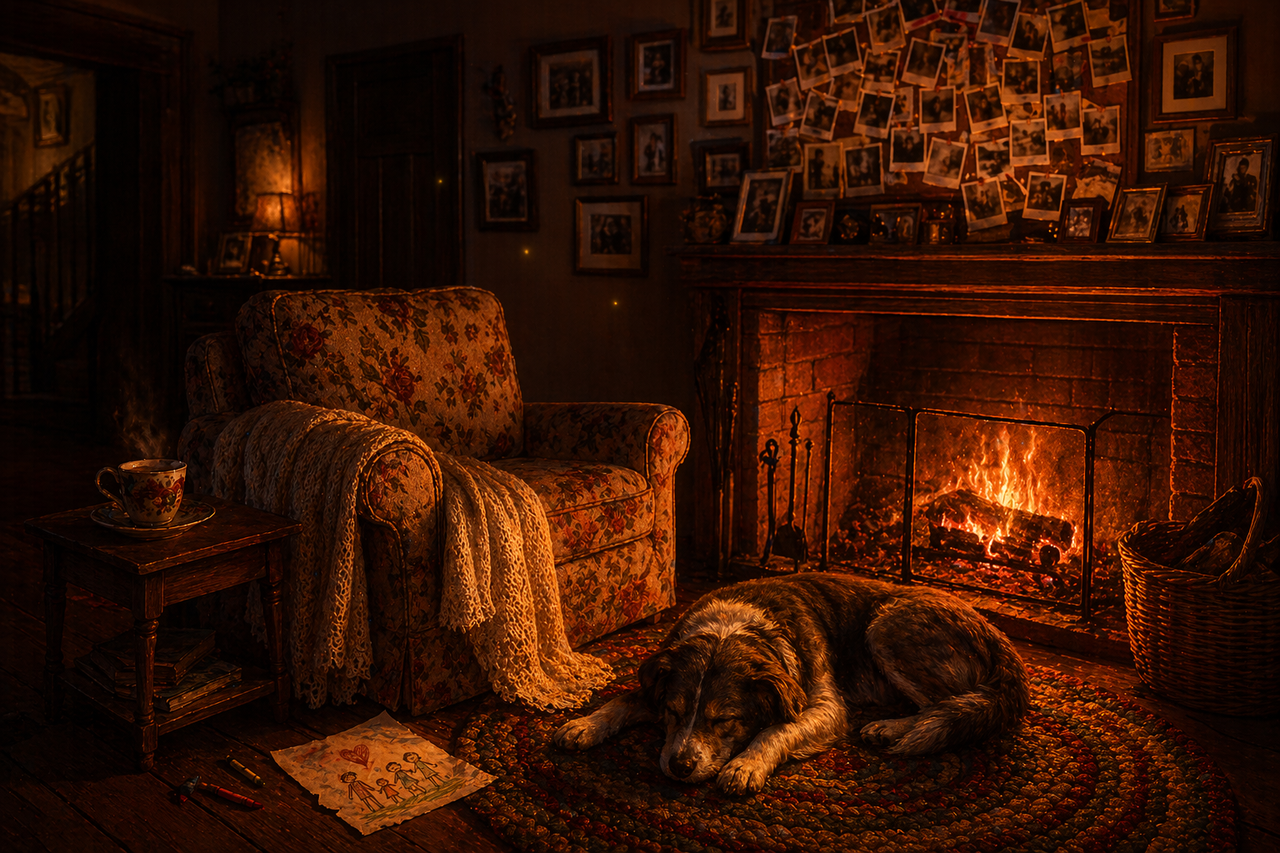
FAMILY · 8 chapters · eight strangers
Where the Hunger Chooses Its Mouth
Chapter 1
, by Colin McAteer
The girl walks into the empty dining hall at 3:47 p.m., which is not a meal time, which is not when anyone should be here. She carries a blue plastic folder under one arm and moves like someone who has practiced being invisible. The tables stretch in long rows, eight to a side, each one capable of seating twelve if you squeeze, ten if you don't. Today they seat no one. She chooses the table third from the windows. Not the first, which would be too obvious. Not the last, which would seem like hiding. The third table is a choice that looks like no choice at all. From the folder she removes a single photograph, edges worn soft from handling. She places it face-down on the table's surface, which is that particular institutional beige that exists nowhere in nature. Then she sits. Then she waits. At 4:02 p.m., an older woman enters through the kitchen doors, wiping her hands on an apron that might once have been white. She stops when she sees the girl. Neither of them speaks. The woman's hands continue their mechanical wiping motion even though they must be dry by now. "You're early," the woman finally says. "The bus came early." "Buses don't come early." "This one did." The woman approaches the table but doesn't sit. She looks at the back of the photograph, at the girl's hand resting near it, at everything except the girl's face. "You brought it, then." "You said to." "I said you could. That's different from saying you should." The girl flips the photograph over. It shows a long table, this table maybe, or one like it. Seven people sit along one side, their faces bleached almost white by an old camera's flash. The eighth chair sits empty. In the photograph, someone has drawn a red circle around the empty chair. The ink has bled slightly into the photo paper, giving the circle a fuzzy halo. "I don't remember this," the girl says, but her voice catches on the word remember in a way that suggests otherwise. The woman finally sits, two chairs down, leaving one empty between them. "Your mother sent you." "My mother doesn't know I'm here." "Your mother always knows." At 4:11 p.m., a third person enters. This one is harder to categorize. Could be twenty, could be sixty. Carries a backpack that clinks softly with each step, glass against glass. Takes the seat directly across from the photograph, studies it for a full minute. "Is this the one where someone died?" this person asks. "No one died," the woman in the apron says. "Someone's always died," says the person with the backpack. The girl touches the red circle in the photograph. Her finger fits exactly inside it. "My grandmother sat here," she says. "Eighth seat. She sat here every Sunday for forty years and then one Sunday she didn't and the next week there were only seven of us and now..." She doesn't finish. The person with the backpack starts removing jars from the bag. Each one contains something different. Pickles in one. Jam in another. In a third, something that might be teeth, though probably not teeth. Probably just small stones. The jars form a line down the center of the table. "Now there are three of us," the woman in the apron says. "Four if you count the one who's coming." "Someone's coming?" the girl asks. "Someone's always coming." At 4:23 p.m., the light through the windows shifts. The photograph on the table seems to darken, or maybe that's just the shadows lengthening. The eighth chair in the photograph looks less empty now. Looks almost occupied by something the camera couldn't quite capture. The girl pulls her hand back from the image. Outside, another bus pulls up to the stop, right on time, which is to say early, which is to say exactly when it needs to be.
Chapter 2
, by typewriter_tom
The fourth person doesn't come through a door. She's just there at 4:24, sitting in the chair between the girl and the woman in the apron, the one they left empty. The girl flinches. The person with the backpack doesn't look up from their jars. "Hello, Iris," the woman in the apron says. The fourth person, Iris, wears a coat too heavy for the season. Her hands rest on the table, palms down. They look wet. "I brought something too," she says. From her coat pocket she pulls a dinner roll. It's hard as ceramic, probably a year old, maybe more. She sets it beside the photograph. It doesn't roll. Sits there like a stone. "From the last supper," the person with the backpack says. Not a question. "From a last supper," Iris corrects. "Not the last one. Just the one where we stopped pretending." The girl stares at the roll. "You kept it." "Someone had to." The woman in the apron's hands have started their wiping motion again, rubbing at the table's surface now, at a stain that isn't there or is so old it's become part of the beige. "We agreed not to do this," she says. "You agreed," Iris says. "I was already gone." The backpack person unscrews one of the jars. The smell hits the air, vinegar and something underneath that's less identifiable. They take out a pickle with their bare hand, bite it, chew slowly. "Gone where?" they ask. Iris doesn't answer. The girl does. "She left the week after the photograph. Didn't tell anyone. Just stopped coming to Sunday dinner." "I told one person," Iris says, looking at the woman in the apron. "Telling someone you're leaving isn't the same as telling them why." "The why was in the photograph." The girl picks up the photograph again, brings it close to her face. Studies each of the seven bleached figures. Her finger moves from face to face. Stops on the third person from the left. "That's you," she says to Iris. "That's all of us," Iris says. "At different times." The backpack person laughs once, sharp. "Bullshit." "Look at the hands." They all look. In the photograph, seven people, seven pairs of hands visible. But the hands don't match the bodies. The hands on the first person are old, liver spotted. The face is young. The hands on the young man at the end belong to a child. And the hands on Iris, in the photograph, look exactly like the hands on the woman in the apron. The girl's voice goes small. "I don't understand." "The table doesn't seat people," Iris says. "It seats versions. Sunday dinner wasn't about food. It was about deciding which version of yourself you'd be for another week." The woman in the apron stands up fast. Her chair scrapes the floor. "Don't," she says. "She came here for answers." "She came here because she's sixteen and stupid and thinks family history is something you can hold like a photograph." "I'm seventeen," the girl says. Nobody responds to that. The backpack person has finished their pickle. They wipe their hand on their jeans, pull out a small notebook, start sketching something. The scratching of pencil on paper is the only sound until the woman in the apron sits back down, slower this time. "The eighth chair," the woman finally says. "It wasn't your grandmother's chair. It was the empty chair. Every table needs one. Somewhere for the version that doesn't get chosen to sit." The girl's hand moves to her own face, touches her cheek like she's checking if she's real. "What happened to her? To my grandmother?" "She chose wrong," Iris says. "Chose the empty chair." At 4:39 p.m., the light completes its shift. The table is now half in shadow. The photograph shows something it didn't show before. An eighth figure, blurred, sitting in that circled chair. The girl sees it. Pushes the photograph away. "I want to leave," she says. "Not yet," says the backpack person, still sketching. "Someone else is coming.
Chapter 3
, by Sammy Hall
The girl stands up anyway, because seventeen means you still think leaving is something you get to decide. Her chair catches on the floor, makes a sound like a question mark. The woman in the apron reaches across the empty space between them but doesn't touch her, just lets her hand hang there in the air like an offer nobody's accepting. "Sit down, Claire," the woman says, and it's the first time anyone's used the girl's name out loud, which makes it real in a way that's worse than when it was just "the girl" in everyone's head. Claire doesn't sit. She's looking at the photograph now, really looking, at that eighth figure that wasn't there a minute ago or was always there depending on how you count time in a room like this. The figure's face is still blurred but something about the posture is familiar. The way the shoulders curve in. The specific angle of the head. "That's not my grandmother," Claire says. "No," Iris agrees. "That's me." The backpack person stops sketching. Looks up for the first time since they bit into that pickle. Their eyes are gray, the kind of gray that makes you think of newspaper left in the rain. "Well," they say. "Shit." The woman in the apron's hand drops back to the table. "You weren't supposed to see that part yet." "What part was I supposed to see?" "The part where we explain it slowly. The part where you understand before you panic." "I'm not panicking," Claire says, but her voice is doing something her voice doesn't usually do, climbing up into her throat and staying there. Iris picks up the fossilized dinner roll, turns it over in her wet hands. Water drips from her palms onto the table. Not a lot. Just enough to leave small dark circles on the beige. "The last supper I meant," she says. "The one where we stopped pretending. Your grandmother was there. You were there too. You were three years old and you sat in her lap and you both occupied the same chair for exactly ninety seconds before the table decided which version got to stay." "That's not how anything works." "It's how this works." Iris sets the roll down. It lands with a sound heavier than bread should make. "Every generation, someone has to sit in the eighth chair. Someone has to be the version that gets edited out. Your grandmother thought she could game it. Thought if she held you while the table chose, it would pick you and save her. Turns out the table's got a sense of humor." The backpack person goes back to sketching. Their pencil moves fast, short strokes. "So what happened?" "It picked both of them," the woman in the apron says. "Or neither of them. However you want to think about it. What walked out of here that day was half Claire, half her grandmother. One body. Two people deciding which version gets to drive." Claire's hand is back on her face, pressing against her cheek like before. But this time she's pressing hard, like she's checking if the bone underneath is shaped the way she remembers. "I don't feel like two people." "You wouldn't," Iris says. "The one who feels it is the one who got erased. The one sitting in the empty chair. And she's been sitting there for fourteen years, waiting for you to come back and finish what your grandmother started." At 4:47 p.m., someone walks through the kitchen doors. Not walks. Limps. An old woman in a housedress that might have been floral once, before the pattern washed out. She's carrying something wrapped in a dishtowel. Her face is the same face as Claire's face, just folded different. Creased where Claire is smooth. The same mouth. The same bad habit of biting the left side of the bottom lip. "Hello, baby," the woman says, and Claire knows that voice. Knows it from somewhere deeper than memory. The woman unwraps the dishtowel. Inside is a serving spoon, silver, the handle worn down from decades of hands. She places it on the table next to the photograph, next to the fossilized roll, next to the line of jars. "I saved your seat," the woman says.
Chapter 4
, by Dan Okafor
Claire sits down. Not because she wants to. Because her legs have apparently read ahead in this script and already know how it goes. The chair receives her like it's been holding its breath for fourteen years. The old woman lowers herself into the eighth chair, the circled one, moving like someone who's learned not to trust furniture. Her knees make sounds. Everything about her makes sounds, actually: the whisper of the housedress, the click of her jaw, the soft percussion of her breathing. Claire wonders if this is what haunting sounds like up close. Rattling chains would be more dignified. "You're dead," Claire says, which isn't exactly what she means but it's close enough for a first draft. "I'm sitting," her grandmother says. "Dead people don't have to worry about their knees." The backpack person has stopped sketching entirely. They're watching now with the attentiveness of someone at a surgery. The kind you're not supposed to film but someone always does. Iris's hands are still wet. The water's been dripping this whole time, these little dark circles spreading across the institutional beige like a very slow decision. "Tell her," Iris says. "Tell her what?" the woman in the apron asks. "The thing we brought her here to tell her." "I thought we brought her here to see if she'd run." "She didn't run." "She tried to run. Her legs just gave up before she made it to the door." Claire's grandmother picks up the serving spoon, balances it across one finger. It doesn't fall. "You all talk too much," she says. "Always have. Sunday dinners were four hours long because nobody could just pass the potatoes without explaining the history of potatoes first." "That was you," the woman in the apron says. "You did that." "I contained multitudes." The old woman looks at Claire, and the resemblance is worse up close. Like looking in one of those aging apps except the app is sitting across from you asking questions with your own eyes. "You know why you came here today?" "The funeral," Claire says. "Whose funeral?" "Yours. They're burying you tomorrow." "They're burying a body tomorrow," her grandmother corrects. "Whether it's mine is the question." She sets the spoon down, carefully, in the exact center of the table. It points at Claire. "How much do you remember about being three?" "Nothing. Nobody remembers being three." "You remember Sunday dinners." Claire opens her mouth. Closes it. Realizes with the lurching feeling of a missed step that she does remember. The long table, which wasn't this table but was definitely a table. The weight of her grandmother's arms. The smell of something cooking, something that took all day. The way everyone's face looked in the steam. "That was you remembering," her grandmother says. "Not me. The table didn't take your memories. Just your..." She waves her hand, searching for the word. "Your precedence. Your claim to being the primary copy." "So I'm what?" Claire hears her voice doing that climbing thing again. "I'm the backup file?" "You're the one who got to grow up," Iris says quietly. "She's the one who got to stay three years old for fourteen years. You want to compare deals, you got the better one." The backpack person finally speaks. "What happens now?" Everyone looks at them. "What? It's a reasonable question. Girl meets her own ghost. Ghost shows up at the haunted table with a spoon. This goes somewhere or we're just doing theater." The woman in the apron stands, walks to the windows, looks out at nothing. "Now we have the dinner," she says. "The one we should have had fourteen years ago. We set the table. We choose." "Choose what?" Claire asks. Her grandmother smiles, and it's Claire's own smile, the crooked one that means trouble. "Which version of you gets to leave," she says. "The one who lived her whole life thinking she was whole, or the one who's been sitting in the empty chair watching you be her." At 4:53 p.m., the backpack person starts removing more jars. The woman in the apron disappears into the kitchen. Iris reaches across and squeezes Claire's hand once, quick, and her palm is cold and wet and feels exactly like telling the truth. The serving spoon stays where it is, pointing.
Chapter 5
, by Cora Lindgren
Claire's hand is still cold from where Iris touched it. The wet transfers, catches in the creases of her knuckles. She wipes it on her jeans and the dampness spreads, darkens the denim in a shape like a continent she doesn't recognize. Her grandmother is humming something. Not a song. Just three notes going around and around, the kind of sound you make when you're cooking and you've forgotten anyone can hear you. The woman in the apron comes back carrying plates. Real plates, the heavy kind with a rim you could chip a tooth on. She sets one in front of each chair, including the empty ones, and Claire counts without meaning to. Twelve places. They're only five people but the table is set for twelve. "We don't have food," Claire says. "We have what we brought." The backpack person is lining up their jars, shortest to tallest now, arranging them with the care of someone setting charges. "Pickles. Jam. This one's full of lake water from the summer everyone got sick. This one's got..." They squint at a jar of something pale and lumpy. "I actually don't remember. I've been carrying it for six years." Claire's grandmother stops humming. "Lake water's no good. That was August 2003. I was already in the chair by then." "So?" "So it doesn't count as a shared meal if I wasn't there to share it." The backpack person shrugs, moves that jar to the end of the line. "Your rules, not mine." Iris gets up and disappears into the kitchen. Comes back with a pot, no lid, the bottom scorched black. She sets it in the center of the table. Inside is rice, maybe two cups of it, dry and uncooked. A few grains spill over the edge and scatter. One lands on Claire's plate. She picks it up. It's warm. "How is it warm?" "Because I've been holding it for an hour," Iris says. "Waiting to see if you'd show." The woman in the apron sits down, finally, in the chair at the head of the table. The position makes her look like someone's mother, which maybe she is, was, will be. Claire doesn't know who anyone is to anyone else in this room except by their props. The apron. The backpack. The wet hands. The housedress that used to be floral. "We need bread," the woman in the apron says. Claire's grandmother picks up the fossilized roll. "We have bread." "We need bread that can be broken." "This breaks. You just need a hammer." "You know what I mean." They sit there, all five of them, looking at a table set for twelve with nothing on it but jars and dry rice and a roll that could be used as evidence in a geological survey. The light through the windows is going orange now, that particular late-afternoon color that makes everything look like it's already a memory of itself. Claire's stomach is doing something. Not hunger. The opposite of hunger, maybe. The feeling of being too full of a meal you haven't eaten yet. "This is insane," she says. "Yes," her grandmother agrees. "We're just sitting here." "Yes." "Nothing's happening." "Something's always happening. You're just not trained to see it yet." Her grandmother reaches across the table, picks up the serving spoon again, but this time she offers it handle-first to Claire. "You know what this is?" "A spoon." "It's the spoon. The one we used every Sunday. The one that served every version of every person who ever sat at this table." The silver is dull, needs polishing. Claire can see her own reflection in it anyway, warped and stretched. "Your mother bent this handle when she was nine. See that kink? She was angry about something, don't remember what, and she gripped it like she was trying to strangle it." Claire takes the spoon. It's heavier than it looks. The handle is warm from her grandmother's hands, and the warmth feels like evidence of something but she doesn't know what. "We can't have Sunday dinner without someone to serve," her grandmother says. "That's the rule. The table feeds versions, but someone has to choose what goes on the plates. Someone has to decide what gets eaten and what gets saved." She folds her hands, those hands that are somehow the same as the woman in the apron's hands if you believe the photograph. "So. Which one of us are you going to serve first?
Chapter 6
, by Sasha Loomis
Claire sets the spoon down. It doesn't point anymore, just lies there being silver and old. "I'm not serving anyone," she says. "I came here because there was an envelope with my name on it and now there's just pickles and a dead woman who isn't dead explaining dinners like they're time machines." "Time isn't the thing that moves at this table," the backpack person says. They've opened the jar of lake water, are looking into it like a crystal ball. Something small is floating in there. Could be algae. "What moves is certainty. Who you are on Sunday versus who you were on Monday. The gap between those two people, that's what we eat." Her grandmother smiles. "He's always been the poetic one." "He?" Claire looks at the backpack person again. They look back. Their face doesn't commit to anything. "Different Sundays," they say. "Different pronouns. The table doesn't care what shape you take to sit in it." Iris has put her hand in the pot of rice, is running the grains through her fingers. The sound is like rain on paper. "Your grandmother brought you here when you were three because she was trying to skip a generation," she says. "Thought if the table took you early, the choosing would be done. No more Sunday decisions. Just Claire, fixed, forever." "But I grew up," Claire says. "You grew into her," the woman in the apron says. "Every choice she would have made, you made. Every word she would have said at seventeen, you're saying now. Look at how you're sitting. Left ankle tucked behind the right. That's her. Look at how you touched your face before, checking the bone. That's her. You're not haunted, baby. You're a very good recording." Claire stands up again. This time her legs let her. She walks to the window, looks out at the parking lot where the early bus came early. There's no bus now. Just painted lines and the memory of vehicles. A seagull lands on the asphalt, screams once, takes off. "The envelope," Claire says, not turning around. "The one with my name. Who wrote it?" Silence, which is an answer. "I did," her grandmother says. "Last week. Walked into the funeral home and wrote it while they were doing my hair. Your mother thought I was in the bathroom." "You were already dead last week." "The body was. I wasn't in it." Claire turns around. "How does a dead person walk into a funeral home?" "Very carefully," her grandmother says. "And wearing better shoes than I'm wearing now. These are the ones I died in. They pinch." She lifts one foot. The shoe is blue, orthopedic, spotted with something dark near the toe. "The envelope said to come here. Didn't say why. I figured you'd know why when you got here." "I don't know anything." "You know how to hold a spoon. That's enough to start." The backpack person has closed the lake water jar, opened another. This one has the maybe-teeth, maybe-stones. They rattle softly. "We're running out of time," they say. "The table only holds the in-between for so long. After that, someone has to be chosen or everyone just becomes the same person at different volumes." Claire comes back to the table. Sits. Picks up the spoon again because her hands need something to do and the spoon is there being useful. The serving spoon. The choosing spoon. "What if I serve myself?" she asks. Iris's hands stop moving through the rice. The woman in the apron's mouth opens, closes. Her grandmother leans back in the eighth chair, in the empty chair that's not empty anymore, and laughs. "Oh," she says. "That's new." "Is it allowed?" "Nothing's allowed. We're making up rules in a room that shouldn't exist for a dinner with no food about which version of a girl gets to keep her name." Her grandmother pushes her plate forward, into the center of the table. "But if you're serving yourself first, you have to decide what goes on the plate. What part of you gets eaten so the rest can stay." Claire looks at the jars. The rice. The fossilized bread. The serving spoon in her hand. The light through the windows is almost gone now. The table is half in shadow again, or maybe all in shadow, or maybe the shadow is coming from underneath. "How much," Claire asks, "do I have to give up?" "All of it," Iris says softly.
Chapter 7
, by Ruth Ann Keller
One ought not to trust a statement like that, delivered in such gentle tones. Claire regards Iris with a wariness she has only recently discovered within herself, though perhaps it has been there all along, simply waiting for an occasion such as this. "All of it," she repeats. The words taste of tin. "Not quite all." Her grandmother shifts in the eighth chair, and the housedress rustles. "There's always a remainder. Something too small to serve, too stubborn to erase. But yes, child. Most of it goes on the plate." The woman in the apron rises and retrieves something from the kitchen. She returns bearing a ladle, tarnished at the bowl's edge. This she places beside the spoon with a deliberation that suggests ritual. "One serves. One pours. That is how it has always been done." "I shall require clarification," Claire says. Her diction has sharpened, though she cannot account for why. "If I serve myself, what precisely am I serving? Memory? Time? The accumulation of seventeen years?" "Appetite," the backpack person says. They have opened the jar of maybe-teeth and are arranging them in a circle on the table's surface. Seven teeth. No, stones. No. Claire blinks and they are teeth again, small as a child's. "You serve what you hunger for. The table consumes it. What remains is what you never wanted in the first place." Claire's grandmother nods. "I wanted to keep being young. So I brought you, thinking the table would take your youth and let me stay as I was." She touches her face, the creased topography of it. "It took the wanting instead. Left me frozen at three years old inside, just wise enough to know what I'd lost, just small enough to fit in this chair forever." The rice in the pot has begun to move. Not wind, no breath disturbs it. The grains simply shift of their own accord, arranging themselves into a pattern Claire recognizes: a photograph's composition, seven figures and one absence. "I wanted certainty," Iris says. Her wet hands are folded now, dripping onto her lap. "Wanted to know which version of myself was true. The table showed me." She gestures at her palms, perpetually damp. "These hands touched the water, felt for the bottom, never found it. I am still reaching. I shall be reaching when they bury what is left." The woman in the apron says nothing. Her silence is its own confession. Claire lifts the spoon. In its tarnished surface, her reflection fractures into multiples: child, teenager, old woman, none of them, all of them. "What I want," she begins. "Is irrelevant," her grandmother interrupts. "Want is the thing you feed to the table. The question is what you want most." The light has failed entirely now. Someone ought to have turned on the overhead fixtures, but no one has moved to do so. The room subsists on what little illumination bleeds in from the kitchen, and it is insufficient. Claire can barely distinguish faces anymore, only the shapes of bodies in chairs, the geography of a table she has somehow always known. She thinks of the envelope. Her name in unfamiliar handwriting that was, she understands now, her own hand as it would have written at seventy-three. She thinks of the blue folder she carried in, abandoned now on a chair at the far end. Inside it, documents: a birth certificate, school records, a driver's permit. Evidence of accumulation. Proof of having happened. "I want to leave," Claire says. Her grandmother laughs, but there is no cruelty in it. "We all want to leave, child. That is not sufficient." Claire grips the spoon more firmly. The handle, kinked from her mother's nine-year-old fury, digs into her palm. "I want to leave as myself. Whole. Unchosen. I want Sunday dinners to be merely dinners. I want this table to release its claim." The backpack person stops arranging teeth. "Oh, that's good." "Is it permitted?" Claire asks. "Nothing is permitted," the woman in the apron says. She picks up the ladle. "But if you serve wanting itself, if you put appetite on the plate and let the table consume it, then what remains is a person who simply is. No hunger. No choice. No more Sundays." "No more you," Iris adds quietly. Claire extends her plate. "Then serve me that." Her grandmother reaches for the ladle. Her hands, when they close around it, are steady.
Chapter 8
, by inkwell_amy
Her grandmother tilts the ladle. Nothing pours out but the air changes weight. Claire feels it first in her teeth, then lower. A hollowing. The table pulls like undertow. She locks her elbows to keep from pitching forward. The plate in front of her shows a reflection that isn't hers. Younger face. Three years old. The mouth is open and screaming but there's no sound, just that pulling. "Hold the spoon," her grandmother says. Claire's already holding it. "No. Hold it like you mean to keep it." The handle is slick now. Claire's palm is sweating or the silver is. She wraps both hands around it. The kink in the metal digs deeper. Her mother bent this. Her mother who is not here. Who maybe doesn't know about tables like this or maybe does and ran. The backpack person sweeps the teeth into their hand. Flings them across the table. They scatter, bounce, one falls into Claire's lap. She picks it up. Warm. Root still attached. "That's mine," Iris says. "From when I was seven and ran into the door." Claire sets it on her plate next to the hollow reflection. "More," her grandmother says. The woman in the apron pours from a jar. Pickle brine hits the plate. The smell makes Claire's eyes water. The reflection of the child in the brine starts aging. Four years old. Five. The face elongates. Cheekbones emerge. The rice pot tips. Grains spill across the table in a line that points at Claire's sternum. One grain for each year. She counts without meaning to. Seventeen exactly. The last one rolls off the edge into darkness. Her grandmother sets down the ladle. Picks up the fossilized roll. Raises it high. "Wait," Claire says. "No more waiting. You asked to be served." The roll comes down. Hits the table. Doesn't break. Hits again. Something cracks. Not the bread. The table. A split runs from where the roll struck, hairline thin, racing toward the eighth chair. Iris stands fast. "You'll break it." "It's been broken," her grandmother says. She swings again. This time the roll shatters. Crumbs scatter. Not crumbs. They're moving. Beetles maybe. No. Too fast. They're just particles of bread accelerating, obeying physics the table invented for itself. One lands in Claire's mouth. She didn't open it. It finds its way in anyway. Tastes like fourteen years ago. Tastes like her grandmother's hands and Sunday gravy and everyone pretending they were whole. She spits it out. "Swallow," her grandmother says. "No." "Then you'll stay hungry." The crack in the table reaches the eighth chair. The chair tips backward. Her grandmother grabs the table edge but she's going with it, the chair and the woman both falling into the split, into wherever the table keeps its discards. Claire lunges. Catches her grandmother's wrist. The backpack person catches Claire's. Iris catches the backpack person's. The woman in the apron doesn't move. Just watches. "Pull," Claire says. They pull. The grandmother rises. The chair doesn't. It goes down into the crack and the crack seals behind it and now there are eleven chairs at a table set for twelve. Her grandmother sits hard in the chair beside Claire. Not the eighth chair. The second. She's breathing like she's been running. "That was not the plan," she says. "Plans finished," the woman in the apron says. She's stacking plates now. Taking them away even though nothing was eaten. The tooth. The brine. The moving crumbs. All of it goes into the kitchen and doesn't come back. Claire still has the spoon. "Keep it," her grandmother says. "I don't want it." "You served yourself. You keep the spoon. That's how it works." The windows are black now. Claire can't see the parking lot. Can't see the seagull or the painted lines or any evidence that outside exists. "What happens now?" she asks. "Now you leave," Iris says. Her hands have stopped dripping. She looks at them, surprised. The backpack person is already gone. Claire didn't see them go. The woman in the apron returns without the plates. "The funeral's tomorrow at ten. You should come." "Will you be there?" Claire asks her grandmother. "No. I'll be here. Someone has to sit at the table." "Alone?" Her grandmother looks at the eleven chairs. The empty place where the eighth one was. "There's always someone coming," she says. Claire stands. The blue folder is where she left it. She picks it up. Walks toward the door. The spoon is still in her hand. Behind her the table waits. She doesn't look back.
· end ·