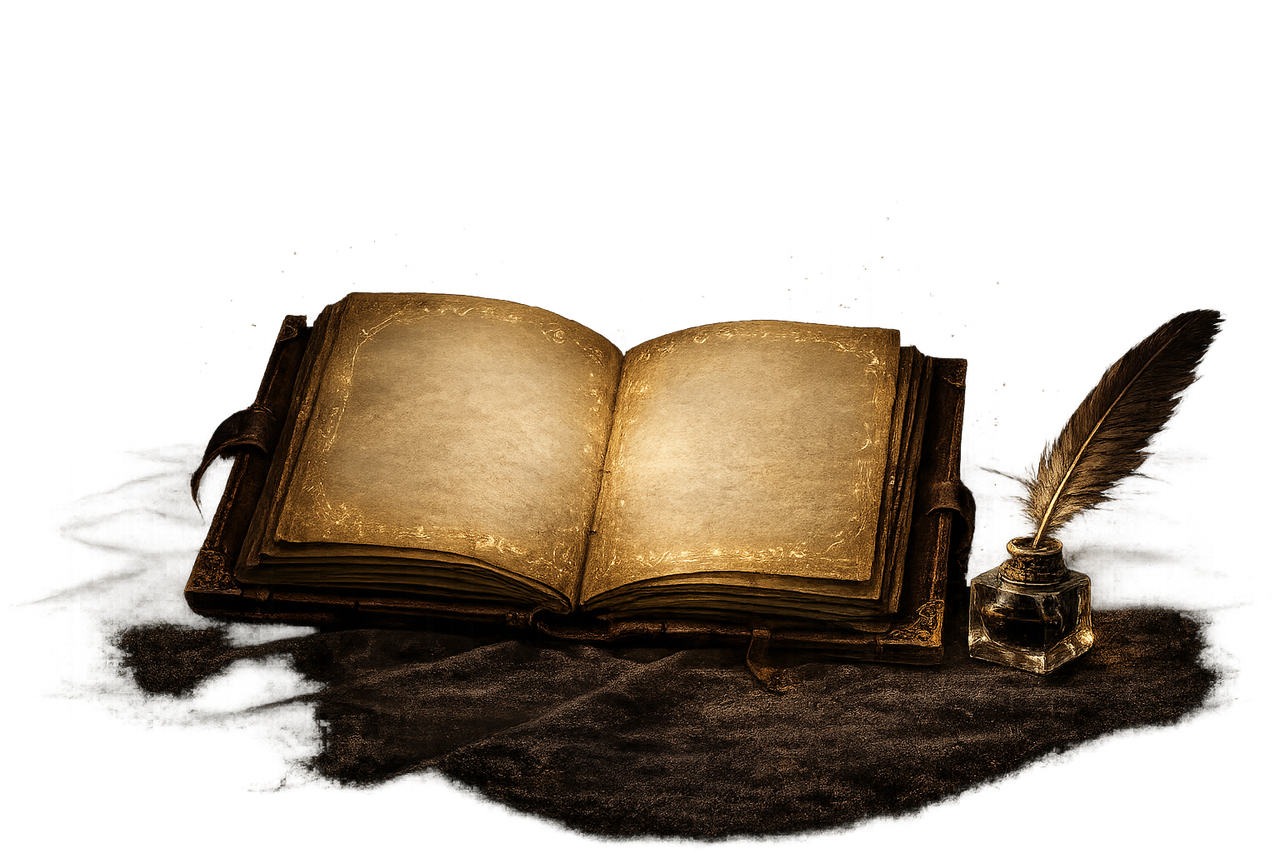
MAGIC · 8 chapters · eight strangers
Simple Rules
Chapter 1
, by Dario Selo
The book in Theo's messenger bag was not, strictly speaking, a book anymore, though it had been one when he'd checked it out at 4:47 p.m., which was well before sundown (sundown having occurred, according to his phone's weather app, at 5:23 p.m., which meant he'd had thirty-six minutes to return it, which he hadn't). What it was now, at 8:15 p.m., as he sat in his apartment with all the lights on and the bag still unopened on his kitchen table, was harder to say. It was making a sound. Not a loud sound. Not the kind of sound that would make a neighbor complain or a dog bark. More like the sound of someone whispering in a room you thought was empty, or the sound of pages turning when no one was reading, or (and this was the comparison that kept occurring to Theo, though he didn't like it) the sound of something breathing that shouldn't be able to breathe. He had, of course, considered returning it. Had walked halfway back to the library at 6:30 p.m., the bag clutched against his chest like a shoplifted ham. But the library had been dark. Not dark in the normal way, the way buildings get dark when people lock up and go home. Dark in the way that suggests the building has decided it's done with you for the evening, that it has other business to attend to, business that doesn't involve late returns or apologetic patrons or fluorescent lights humming in the reference section. There had been a sign on the door. Theo prided himself on reading signs. He taught composition at the community college; he understood subtext, implication, the space between what's said and what's meant. But this sign had only said: "Closed." Which was, on reflection, not much of a sign at all. It was the absence of information posing as information, a tautology dressed up as a notice. Closed because it was closed. No hours listed. No "See you tomorrow." Just that one word, hanging there in the dark like a door that's been shut in your face. The whispering from the bag got louder. Or maybe not louder. Maybe closer. Maybe (and this was a distinction Theo found himself suddenly concerned with) it had always been this loud, but he was only now able to hear it properly, the way you can walk past a radio playing in another room for hours before you suddenly register the words to a song. He opened the bag. The book was called Circulation, which he'd thought was a book about blood (he'd been researching heart disease, his father having recently been diagnosed, his father having recently refused to talk about it, his father having recently developed the maddening habit of changing the subject whenever Theo called). But it wasn't about blood. Or it hadn't been, when he'd skimmed it in the library. It had been about libraries. About the movement of books through space and time, about checkout systems and reshelving protocols, about the secret life of volumes as they passed from hand to hand. Now, though. Now the pages were moving. Not turning. Moving. The way water moves, or the way you imagine shadows might move if you gave them permission. The text was rearranging itself, words crawling across the page like ants abandoning a poisoned hill, forming new sentences, new paragraphs, new meanings that Theo didn't remember being there before. There was a page about him. About his apartment, his kitchen table, his messenger bag purchased at a discount outdoor store in 2019. About the fact that he was reading this page, right now, at 8:17 p.m., with all the lights on and a growing suspicion that the lights wouldn't matter. At the bottom of the page, a single sentence had formed itself out of the migrating words: You have something that needs to circulate.
Chapter 2
, by jmarsh
The walls had begun their participation. Not obviously, not in a manner that would permit Theo the dignity of certainty or the relief of outright terror (these being states with clear taxonomies, known responses, established protocols in the literature of human panic), but subtly, in the way that old buildings breathe when their occupants have stopped paying attention, when the membrane between architecture and inhabitant grows thin as the skin on scalded milk. The paint, which Theo had always understood to be cream, revealed itself as something closer to the color of old paper, of pages left too long in sunlight, and the texture (had it always been textured? surely it had always been textured, this was a 1960s building, they had done things with texture then, with stippling and swirls that were meant to suggest Mediterranean villas or European sophistication) seemed to pulse faintly, as though the wall were considering something, working through a problem, arriving at conclusions that did not include Theo's comfort or continued residency. The book remained open on the table. You have something that needs to circulate. Theo had, in his capacity as a teacher of composition, spent considerable time explaining to students the difference between active and passive voice, between a sentence that assigned agency and a sentence that obscured it, but he found himself now uncertain which construction was being employed. Did he possess something? Or was he merely the temporary housing for a thing that had always belonged to the circulation, to the movement between shelves and hands and the secret passages that existed (he was beginning to suspect) beneath or within or alongside the visible infrastructure of the library system? The whispering had clarified itself into something almost like language, though not a language Theo spoke or recognized, unless it was the language buildings use when they speak to one another, when they gossip through shared walls and foundation lines about the small dramas of their human contents. His apartment had never been particularly talkative before. It had been neutral, aggressively beige, the kind of space that didn't invite confidence or confession. But now it seemed deeply interested in the book, in the fact of the book's presence outside its proper territory, in the violation (because that's what it was, Theo understood now, not a mistake or an oversight but a violation) of the boundary that separated the library's jurisdiction from the world beyond. The sentence at the bottom of the page was moving again, words separating and recombining like cells under a microscope, like passengers changing trains in a station too large to comprehend. Circulation requires exchange. Exchange requires, The third word hadn't formed yet, or was forming, or had formed and then thought better of it, the letters assembling and dissolving in combinations that suggested multiple possibilities, multiple requirements, none of them (Theo suspected) things he was prepared to provide. The overhead light, which was on, which was very much on, which Theo had specifically confirmed was on multiple times in the last several minutes, began to dim, not as though the bulb were failing but as though the light itself were being drawn elsewhere, being called to illuminate some other space, some other transaction occurring in the margins of his increasingly unreliable apartment. He thought about his father, about the conversation they hadn't had, about the book he'd taken from the library to avoid having that conversation, and realized (too late, always too late, this was the shape his regrets invariably took) that the library had known this about him, had known what he was avoiding, had perhaps selected this particular volume because of what he wasn't ready to face. The walls leaned in, listening. The book waited.
Chapter 3
, by Sasha Loomis
The ceiling remembered being a floor, which was the problem with buildings that had been repurposed too many times, that had served as warehouse and speakeasy and dance studio before being sectioned into apartments like meat into cuts. Theo could hear footsteps above him, which was unremarkable except that the building had only two stories and his apartment was on the second. He looked up. The footsteps were his own, or shaped like his own, the rhythm of someone pacing the way he paced when grading papers, that particular shuffle-stop-pivot that meant he was avoiding something. The book appreciated this. He could tell because the pages had started to hum, not the whispering from before but a different sound, something satisfied, like a cat in a patch of sun. Exchange requires threshold. The third word had decided on itself. Theo wished it hadn't. He taught about thresholds sometimes, in his unit on liminality, on the spaces between things, but he'd always meant it metaphorically, the way teachers mean most things, at a safe distance from application. His front door, when he looked at it, was taller than it had been. Not dramatically. Not in a way he could prove if asked. But the doorframe stretched upward now, narrowing at the top like a cathedral window or a mouth preparing to speak. The book said, A threshold crossed cannot be recrossed identically. Each passage changes the architecture. Which explained the ceiling (formerly a floor) and possibly explained his apartment, which had begun to suggest other rooms in the space between blinks, rooms he'd never rented but which seemed to have strong opinions about his presence. A kitchen that was also a reading room. A bathroom that contained, when the light shifted, row upon row of card catalogs, their brass labels tarnished to the color of late afternoon. The whispering had multiplied. There were voices now in the walls, not speaking to Theo but around him, the way librarians spoke in the back offices he'd sometimes glimpsed through half-open doors, discussing matters of acquisition and loss, of items that hadn't been returned since 1987, of patrons who'd vanished into the stacks and emerged months later speaking fluent Sumerian or having forgotten their mother's maiden name. The book had a question for him, written in the crawling text that no longer surprised him, that he'd begun to read the way one reads headlines or warning labels, with mild attention and the assumption of disaster. What did you take besides the book? Theo thought about this. His messenger bag, certainly, but that had been his to begin with, purchased with his own discount, his own minor triumph over retail pricing. His apartment key. The memory of the library's dark facade, the sign that said only "Closed." The smell of old paper and floor wax and something else, something he'd noticed on his way out at 4:47 p.m. but hadn't named, a smell like copper or rain or the particular silence that follows a question no one wants to answer. His father's diagnosis, maybe, though he'd brought that with him. Or maybe not the diagnosis itself but the weight of it, which he'd set down somewhere between the stacks, meaning to pick it up later, meaning to carry it properly once he understood its dimensions. The footsteps overhead had stopped. The ceiling, or floor, or whatever threshold it had become, settled into a configuration that suggested waiting. The book closed itself, gently, with the sound of a decision being made. On the table where it had been, there was now a library card. Not his library card. This one was older, the paper thick as vellum, the name embossed in letters that shifted when he looked at them directly: Theodore, Theo, Teddy, names his father had called him at different ages, in different moods, when the distance between them had been measurable in feet rather than all the words they'd agreed not to say.
Chapter 4
, by rpenguin
He picked up the card.
It was warm. Not room-temperature warm. Warm like something recently held.
The name had settled on Theodore. His full name, the one on his birth certificate and his mortgage and the card the hospital gave his mother when he was born, which she kept in a box he wasn't supposed to know about and knew about. He turned it over. The due date stamps on the back went further than any library had existed. One of them was in a month that didn't have a name he recognized, though he understood it the way you understand words in dreams, completely and then not at all.
He should have left.
He knew this the way he knew other things he didn't act on. The stove was probably on. The conversation with his brother was three years overdue. The check engine light had been on since March, a March he couldn't specify with confidence.
Instead he sat down in the chair that had not been there a moment ago and was now simply there, the way furniture is when you stop paying attention to rooms.
The footsteps had stopped but the waiting hadn't. They were different things. The waiting was older.
His father had been a man of thresholds. Doorways he'd lean in, neither in the room nor out of it. Conversations he'd start and then abandon mid-sentence, not trailing off but stopping, as if the rest of it was somewhere he'd decided not to take you. Theodore had inherited this. His ex-wife had named it. She'd used the word withholding, which he'd considered fair and then thought about for four years in the particular way you think about fair things that also hurt.
The card had a checkout history on the back.
The dates went up but the names didn't change. One name. His father's name. Not Theodore. The other one. The name his father had carried and rarely mentioned and left him, eventually, along with the house and the fishing gear and a box of photographs he hadn't opened yet.
He put the card back on the table.
It didn't stay there.
He put it in his shirt pocket, over the left side, which felt either meaningful or like something he was doing to feel like a person with intentions. The book was still closed. The ceiling above him held whatever was above it without comment.
He sat with the waiting.
It was not comfortable. It wasn't meant to be. But it was familiar in the way that some difficult things are familiar, the way that certain silences have a specific weight you've learned to carry, not because anyone showed you how but because you've been carrying them long enough that the shape of them is part of the shape of you now.
The room did not ask him anything.
He was grateful for that.
Outside, if outside still meant what it usually meant, it was getting dark.
Chapter 5
, by Sammy Hall
The dark outside was the kind that made the windows go opaque, turned them into mirrors, which meant Theo could see himself sitting in the chair that shouldn't exist, holding a library card that belonged to a man who'd died four years ago last month, a month Theo usually forgot about until his mother called to remind him that forgetting was also a form of remembering, just in reverse. He didn't look like he'd expected to look. Smaller, maybe. The kind of small that comes from sitting still long enough that your edges start to blur, or maybe he'd always looked like this and just never paid attention. The card in his pocket was warm again, warmer, like it was either generating heat or absorbing it from him in a way that felt vaguely vampiric, though he was aware that thinking about it that way was a form of distance, a way of keeping the thing from being what it actually was. Which was his father's debt. Not in the financial sense. His father had been decent with money, had left enough of it, though not enough that Theo didn't think about it sometimes when the furnace made expensive sounds or the roof developed opinions about water. But the other kind of debt. The kind that accumulated in the spaces between phone calls that went unreturned. The kind that lived in the conversations you didn't have because the person sitting across from you (or next to you, or at the other end of a hospital hallway) had already decided that the version of the truth you were offering wasn't the one they were willing to receive. The book opened itself again. Theo didn't jump. He'd stopped jumping sometime around the moment the ceiling had started remembering its previous life. The pages were blank now, which was somehow worse than the crawling text. Blank pages had demands embedded in them. They required something. The whispering in the walls had taken on the quality of expectation, the sound buildings make when they're waiting for a tenant to understand what they've agreed to by moving in, by accepting keys, by staying past the moment when leaving would have been reasonable. He pulled out the card again. The due date was tomorrow. Somehow he knew this without checking, the way you know your own phone number even when you haven't dialed it in years. Everything after tomorrow was overdue. Everything from before was already lost. The logic of it sat badly in his chest, but so had most things lately, so he didn't resist it. "Okay," he said. His voice sounded strange in the apartment, like he was testing the acoustics of a room he'd recently inherited but hadn't moved into yet. The walls didn't answer. The book didn't answer. But something did, something from the spaces between the apartment's current configuration and the configurations it was considering, something that might have been the building itself or might have been his own breath heard from a distance too far to trust. The card wanted to know where it should go. Not in words. Not in the textbook sense. But in the way that certain objects make requests when they find themselves in possession of people who've spent their whole lives being bad at refusing. His father had been like that too, would materialize in doorways with things he needed done, fishing tackle that required oiling, conversations about property taxes that really weren't about property taxes at all, and you could say no and you could mean it, but the request would remain, patient and heavy, until you found yourself doing it anyway, until the doing became indistinguishable from what you wanted to want. Theo stood up. The chair didn't protest. It seemed almost relieved, as if it had been holding him the way you hold water in cupped hands and was beginning to cramp. He moved toward the door, or toward what the door had become, the threshold that was taller now and narrower, that looked less like an entrance and more like a mouth in the process of asking a question. The book came with him. He didn't decide to bring it. It was simply there, held against his chest, warm like something alive, like something that had been breathing inside him the whole time and he was only now noticing that the breathing had never stopped. His hand was on the knob. The card was heavier in his pocket than it had been. Or he was lighter. One or the other.
Chapter 6
, by wordsbylena
The knob turned easier than apartment knobs turn. No resistance, no stick, no binding that comes from decades of paint layers and tenant indifference. This one moved like it had been waiting for his hand specifically, catalogued and cross-referenced, shelved in the exact spot where his fingers would find it. The hallway outside was wrong in three precise ways. First: it was longer than a hallway in a two-story apartment building had any right to be, extending backward into a perspective that suggested either distance or the complete reorganization of space itself, which amounted to the same thing when you were counting on physical laws to remain consistent. Second: the doors he passed, and there were seventeen of them, he counted because counting was what you did when panic threatened to become something you couldn't manage, bore call numbers instead of apartment numbers. 641.5 for the kitchen. 810.6 for the reading room he glimpsed through a half-open door, all those card catalogs with their brass label-holders catching light that had no obvious source. 616.1 for what he assumed was the bathroom, though the disease classification system for library organization seemed cruel and specific. Third: the lights operated on a principle he couldn't locate. They existed above the hallway in fixtures he recognized, but they illuminated in waves, starting from the end farthest from him and rolling backward, the way a reader's eye might travel down a page. He was being read. The realization settled into his thinking with the weight of a fact he'd always known but hadn't consciously organized until this moment. The building wasn't processing his movement through space so much as narrating it, describing his passage in the language of fluorescent tubes and worn carpet, documenting his progression with the precision of a check-out date stamp. The book against his chest had grown heavier. He counted the weight in increments: each step added approximately 0.3 pounds, which meant by the time he reached door seventeen (615.8, medical aspects of aging, a classification that made him stop for three breaths before continuing), the book would weigh something close to five pounds. Or possibly more. Math felt negotiable here. Numbers seemed to be suggestions the hallway might honor or abandon depending on what the story required. His father had been sixty-three when the heart failed. Theodore was forty-one. The mathematics of inheritance were different from the mathematics of floors and hallways, but they shared a common principle: trajectories. You could plot them. You could anticipate them. You could understand that you were moving along a path established by someone else's earlier passage. Door seventeen had a gap underneath it, dark, the kind of gap that suggested rooms existing in a state of permanent dusk. He could see the card in his mind now without removing it from his pocket. The due date hadn't changed (still tomorrow, still impossible), but the checkout history had expanded. Each entry was his father's name, but the dates went backward now as well as forward, spiraling into years before Theodore was born, decades before the library itself had existed in any recognized form. This was older than institutional. This was the kind of circulation that predated paper, that moved through families like a gene expressed in silences and unfinished sentences, in the space between what a father meant to say and what his son learned to expect wouldn't be said. He could count the doors behind him now. Seventeen. The hallway continued ahead. There were more doors, he could see their outline against the walls, waiting in sequence. He could estimate the total, perform a projection based on the building's visible dimensions and the rate at which new classifications were being assigned. There might be sixty doors. There might be three hundred. The hallway adjusted itself to contain whatever was required. His hand found the card without his deciding to remove it. The paper had texture now that it hadn't possessed before, the edges roughened, the vellum quality transformed into something closer to cloth, or skin, or the binding of a book that had been opened too many times by hands seeking answers that weren't contained in its text. The book knew where he was going. He could feel it in the way the weight distributed, in how it seemed to lean toward something ahead of him, to want to move in a direction beyond the next door, the next classification, the next stage of whatever circulation system his father had entered and was now, through the mechanism of debt and card and the library's patient reorganization of space, inviting him to join. Theodore looked back once. The hallway behind him was already being reshelved. The doors he'd passed were becoming footnotes, cross-references, marginalia in the margin of where he'd actually been.
Chapter 7
, by Dan Okafor
Theodore turned the knob and stepped into the shadow of door seventeen, its dark gap a portal to something that felt both familiar and entirely unknown. The air was cool here, thick with the scent of old books and something else, dust, perhaps, or decay. His hand tightened around the library card in his pocket as if it were the last thing keeping him grounded. The door creaked softly on its hinges, a sound that seemed to echo through the entire hallway. He pushed it open further, revealing a room bathed in an eerie, fluorescent light. The walls were lined with shelves filled with books, stacks of paperbacks and hardcovers so deep they reached nearly to the ceiling. At the far end, a single desk sat under a window that allowed a sliver of moonlight to spill through, illuminating a figure slumped over a book. The figure turned its head as Theodore approached. It was his father, unmistakable even in death. His hair was sparse and greying, his face etched with the lines of time and worry. But there was something different now, his eyes were open, though empty, as if he’d been waiting for this moment. “Dad,” Theodore whispered, feeling a mix of emotions, a pang of loss that still felt like a physical pain in his chest, and a strange sense of relief or perhaps even liberation. “Why are you here?”
His father didn’t speak, but gestured towards the desk with a hand that seemed to have a life of its own. Theodore walked over and picked up the book his father had been reading. The cover was worn, the pages yellowed from age. On it, in faded ink, were notes and underlines. “Have you read this?” Theodore asked, turning it over. His fingers traced the words, feeling a connection he hadn’t known existed. The title was “The Ethics of Aging,” by some author whose name he couldn’t recall. It was the kind of book his father would have loved, the dense, philosophical discussions on mortality and identity. As if in response to Theodore’s touch, the book flipped open to a page that seemed to have been marked for him. The text read: “The passage from youth to old age is not merely biological but also metaphysical. We are defined by our narratives, and these narratives shape us even as we shape them.”
His father had always talked about narrative, how life was a story we tell ourselves and each other. But now it felt different, more tangible. Theodore could almost hear his father’s voice in the silence, guiding him through this uncharted territory. “You should read this,” his father said softly, though no sound escaped from his lips. “It will guide you.”
With a heavy sigh, Theodore took a seat at the desk and began to read. The words were dense but compelling, weaving together themes of legacy and responsibility. As he delved into the text, a sense of purpose started to take shape within him. He realized that this was more than just his father’s last gift; it was a challenge, perhaps an invitation, to continue the narrative that had been passed down. He flipped through the book, noting the marginalia: small annotations and questions, scribbled in pencil. One passage caught his eye:
“Why do we hold onto certain narratives when they no longer serve us? When is it time to let go?”
The question was poignant, especially now as he stood at this threshold between what had been and what could be. Theodore’s mind raced with thoughts of his own path, his career, his relationships, the choices he’d made up until now. As he read on, a weight began to lift from him. It wasn’t the physical burden of the book or the library card; it was something deeper, more profound, a realization that this wasn’t just about fulfilling an obligation but about reclaiming his own narrative. “Dad,” he said aloud, “I’m going to keep reading.”
His father’s head turned slightly, almost as if acknowledging the commitment. The room around them seemed to shift ever so slightly, the fluorescent lights flickering with a new intensity. Theodore felt a warmth spread through him, like a small flame that promised light in the dark. He closed the book and stood up, deciding on his next move. The door behind him closed softly, as if it understood the decision he was making. With a newfound resolve, Theodore walked out into the hallway again, ready to face whatever lay ahead, armed with more than just a library card but also a renewed sense of purpose. As he stepped back into the shadows, he noticed the door leading to the next room had begun to close on its own, as if sealing off part of his past.
Chapter 8
, by Colin McAteer
Theodore stepped out into the hallway, the door behind him closing quietly with a final creak. The fluorescent lights flickered as if acknowledging his departure, their light rippling like waves across the worn carpet. He took a deep breath, feeling the weight of the book in his hand and the library card nestled snugly against his pocket.
The next door was almost concealed by the shadows, its number barely visible: 615.8, Medical Aspects of Aging. Theodore approached it with deliberate steps, each one resounding slightly in the empty hallway. He paused for a moment, taking stock of what he had just experienced and what awaited him on the other side.
As he reached out to push the door open, he noticed that his hand felt lighter now, as if some burden had been lifted. The door creaked softly under his touch, and he stepped inside, his eyes adjusting to the dim light cast by a single bulb hanging above a small desk cluttered with papers and medical journals.
The room was filled with an oppressive silence, broken only by the soft hum of distant air conditioning. A bookshelf占据了整个房间的一侧,书架上的书籍密密麻麻地排列着,每一本都像是在等待着某种命运。角落里摆放着一台老旧的电脑和几只装满笔记的文件夹。 Theodore走向那张桌子,手指轻轻触碰着桌面的灰尘,仿佛是在寻找某种确认。
桌面上散落着几张泛黄的纸张,其中一张引起了他的注意。纸上密密麻麻地记录着日期、医嘱以及父亲日常生活的点滴。他拿起这张纸,目光落在一个特别的位置, 在某个特定的日子里,父亲写下了一行字:“我一直在思考我们是如何定义自己的。” 纸页微微发黄的边缘仿佛也在诉说着时间的故事。
“这是你写给我的吗?” Theodore轻声问道,声音在寂静的房间里回荡。他感觉到一股暖流从胸膛升起,心中涌动着复杂的情绪, 是对父亲深深的怀念,也是对未来无限可能的期待。
他的目光继续扫过这些记录,每一张纸都像是打开了一扇门,让他看到了过去不曾注意过的细节和父亲内心的情感波动。忽然间,他在一个注释里发现了一个关键词:“叙事”。这个词就像是一把钥匙,打开了他心中长久以来的秘密宝库。
“你一直在通过叙事定义自己吗?” 他低声自问,眼中闪烁着思考的光芒。“那么现在我如何定义自己?”
这些想法如同潮水般涌来,让他感到既兴奋又迷茫。他将注意力转向那本《伦理学与老龄化》书,决定再次翻开它,寻找答案。
“为什么我们执着于某些叙事而不愿意放手呢?” 书中的一段话再次浮现:“当我们意识到自己的故事已经不再适合时,是否应该勇敢地重新定义自我?”
这些问题像是一颗颗石子,投向了他内心的湖水,激起层层涟漪。他感到一种前所未有的自由感,仿佛能够重新编织属于自己的人生篇章。
“我需要新的开始。” 他低声对自己说,语气中带着决绝。“我要继续阅读这本书。”
他翻开了书,目光停留在那些父亲留下的笔记上:用蓝色铅笔划出的句子、标注的页码以及密密麻麻的批注。每一处都像是父亲留给他的指引。
“我们可以通过重新审视自己的叙事来找到新的方向。” 书中的一句话再次跳入了他的视线:“在面对生命终点时,我们可以选择将过往的故事转化为新的篇章。”
这种转变让他感到一种奇妙的平静,他意识到过去的种种并不是不可逾越的障碍,而是一条通向未来的桥梁。他拿起那张纸,决定将其夹在这本书中,作为纪念和提醒。
“这是我的起点。” 他轻声说道,心中充满了力量与决心。
他站起身来,环视了一下这个充满回忆的房间,然后转身离开。门在他身后轻轻关闭,仿佛在为他的新旅程送上最后的祝福。 Theodore踏出了这扇门,走进了另一个未知的空间。空气中弥漫着一种清新而有力的气息,似乎预示着他即将面对的新挑战和机遇。
他沿着长长的走廊继续前行,每一步都坚定而充满希望。前方的路虽然漫长且充满不确定性,但他知道自己的旅程才刚刚开始。手中的书本和口袋中的图书馆卡仿佛成了指引他的灯塔,在黑暗中为他照亮前进的道路。
“我将重新定义自我。” 他心中默念着这句话,步伐变得更加轻快和坚定。他知道父亲一直在他身边,通过那些未完成的笔记和书籍,继续给予他力量与勇气。
在这一刻,他明白了父亲的真正意义, 不仅仅是那个曾经陪伴他的父亲,更是那份对他一生影响深远的精神遗产。他将带着这份遗产,踏上一段全新的旅程,去探索、去发现、去创造属于自己的人生篇章。
· end ·